Seoul Climate Card Tourist Pass 2026: What Changed and What to Buy
This post contains affiliate links. If you book through them, we may earn a small commission at no extra cost to you.
“Wait, is the Seoul Climate Card actually ending? I just read that and now I’m not sure what to buy.”
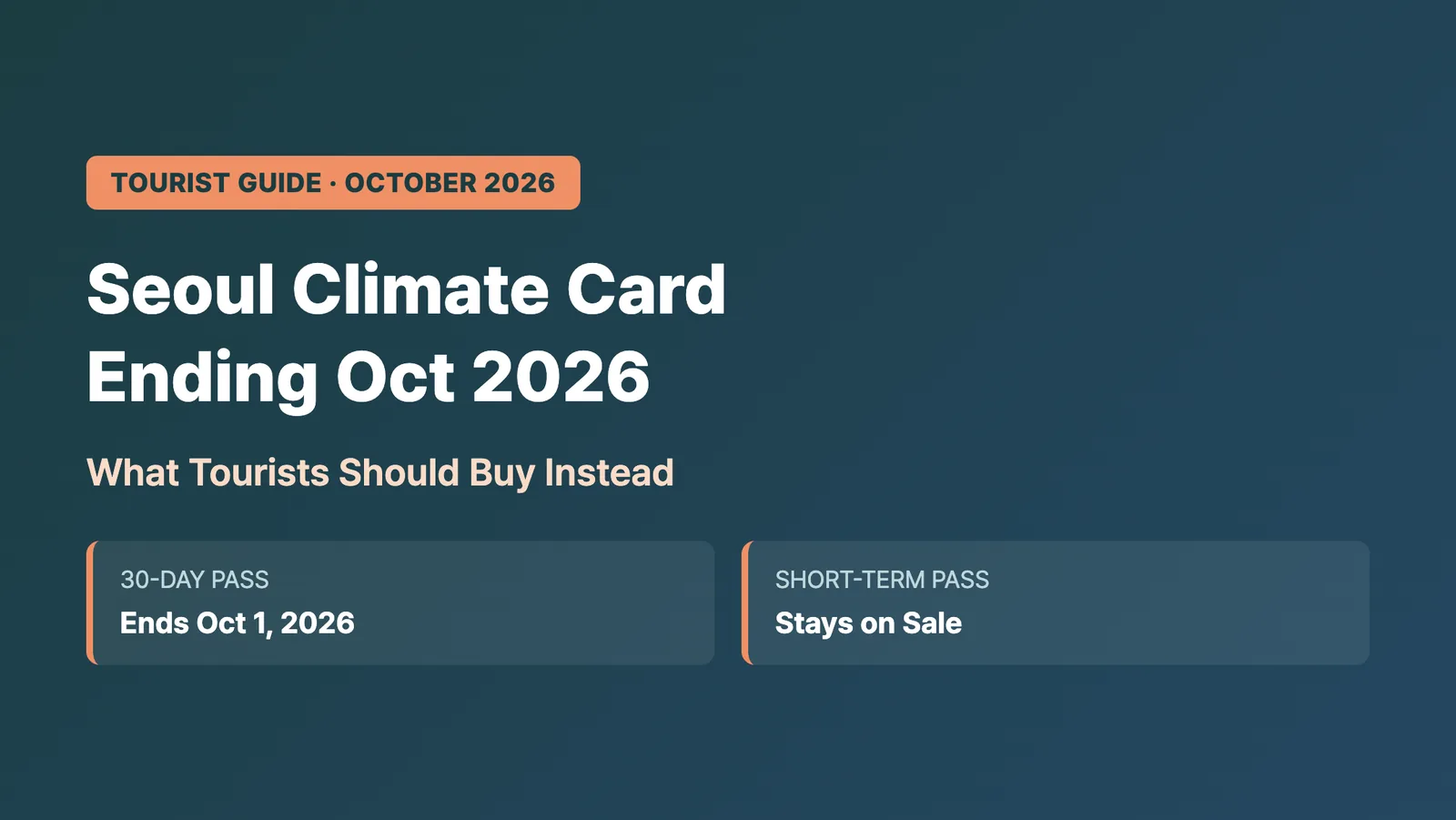
If you’ve seen that headline on a travel forum, you’re not imagining things, but the real story is more specific than “it’s ending.” Here’s the answer up front: only the 30-day Climate Card (the pass mainly used by Seoul commuters, both prepaid and postpaid) is being discontinued on October 1, 2026. The short-term passes tourists actually use, the 1-day, 2-day, 3-day, 5-day and 7-day Climate Cards, are staying on sale. Nobody is taking away the pass you’d buy for a weekend in Seoul.
There’s a second, quieter change that matters more for your trip: starting the same day, the area where a short-term pass works shrinks to Seoul city limits (plus exiting, not boarding, at Incheon Airport). If your plans include Gimpo, Goyang, Gwacheon, Guri, Seongnam, Hanam or Namyangju, read section 2 before you build your route.
Below, I’ll walk through exactly what changed, what a short-term pass costs, whether it’s actually worth buying over regular T-money, and how to pay for it with a foreign card.
1. What’s Actually Changing to the Climate Card on October 1, 2026
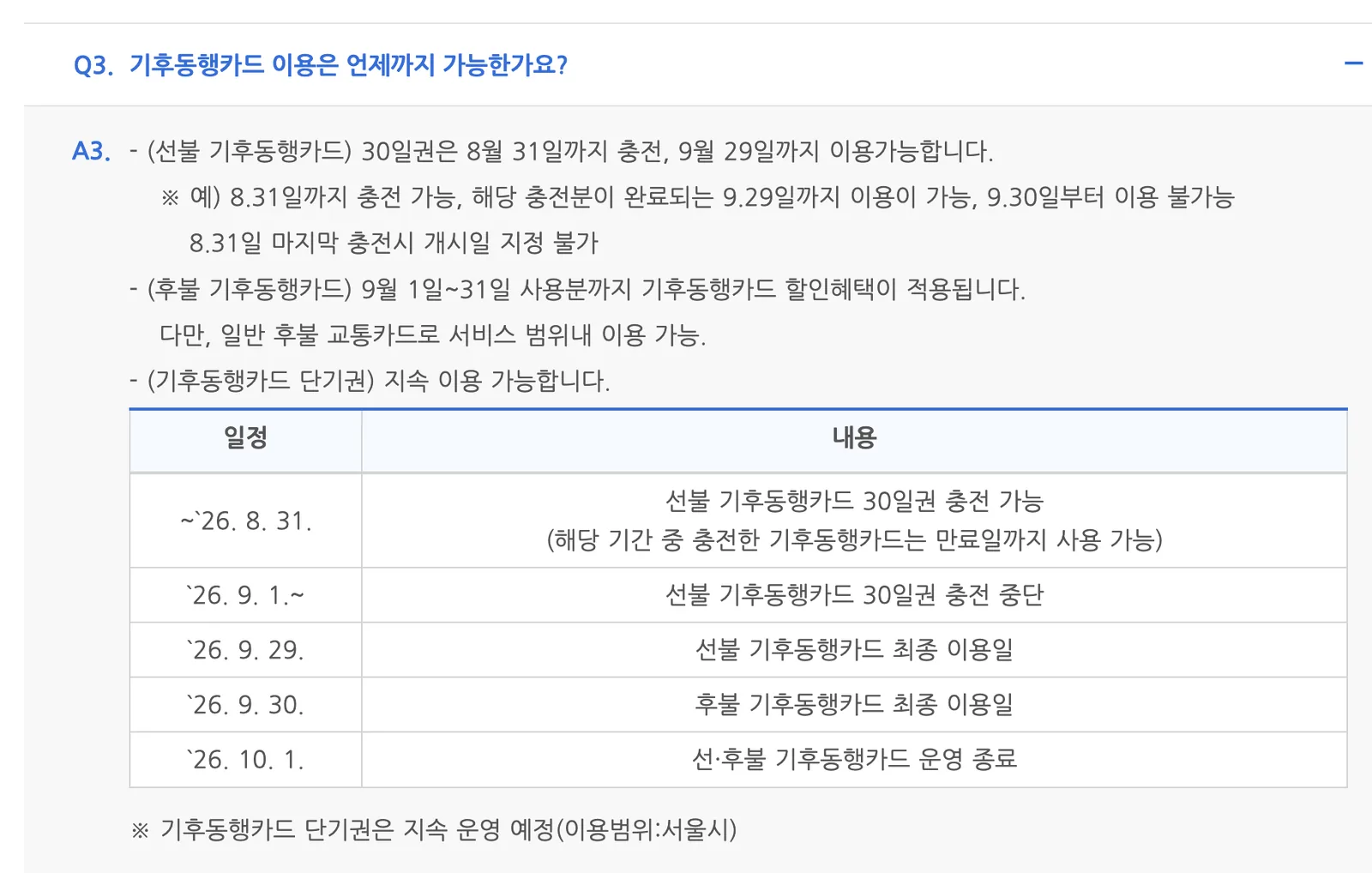
Source: Seoul Metropolitan Government (news.seoul.go.kr), captured 2026-09-30
According to Seoul’s official FAQ page on the shutdown, here’s the exact schedule:
| Date | What happens |
|---|---|
| Through Aug 31, 2026 | Last day to top up (recharge) the prepaid 30-day Climate Card |
| From Sep 1, 2026 | Prepaid 30-day top-ups stop |
| Sep 29, 2026 | Last day of use for the prepaid 30-day Climate Card |
| Sep 30, 2026 | Last day of use for the postpaid Climate Card |
| Oct 1, 2026 | Both prepaid and postpaid 30-day Climate Cards are discontinued |
Seoul’s FAQ is explicit that the short-term pass is a separate product and is planned to keep operating as-is. That’s confirmed on the same FAQ page, and both Seoul’s English site and the Korea Tourism Organization’s VisitKorea page say the same thing.
Why is this happening at all? Per the FAQ, the national government launched a program known as “Modu Card” (K-Pass, sometimes called “Everyone’s Card”) in 2026 with essentially the same unlimited-ride concept and price as the Climate Card, so Seoul is retiring its own 30-day product to avoid running two near-identical programs side by side.
What this means for you as a tourist: if you were only ever planning to buy a 1-, 2-, 3-, 5- or 7-day pass, none of this shutdown actually touches your purchase. You can still walk up to a machine and buy one after October 1. The part that does affect you is next.
2. New for October: Climate Card Short-Term Passes Now Cover Seoul Only
This is the detail most existing guides, including our own earlier one, haven’t caught up on yet, so pay attention here.
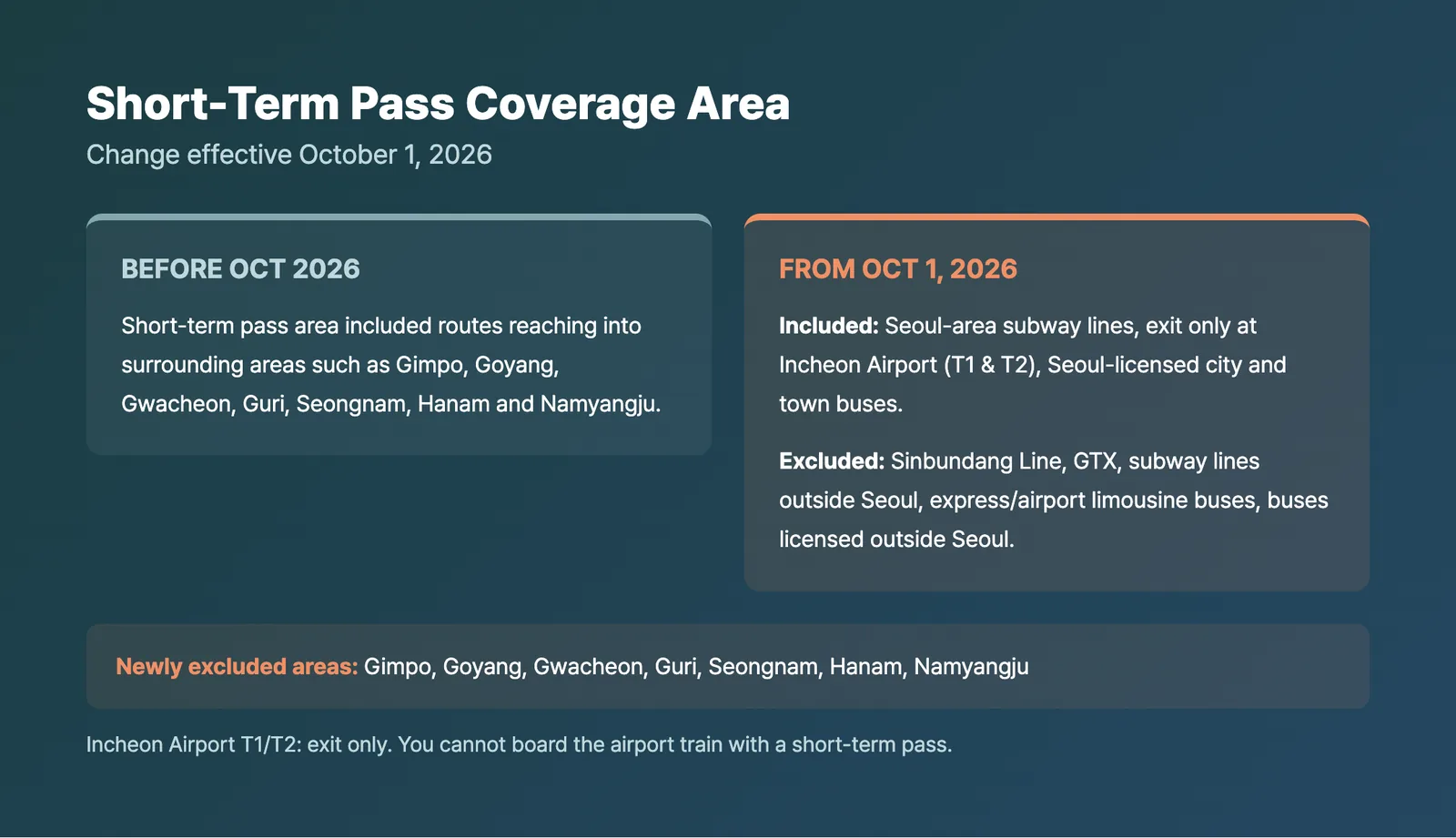
As of October 1, 2026, Seoul’s official short-term pass page (updated Sep 28, 2026) defines the coverage like this:
- Included: Seoul-area subway lines, exit only at Incheon International Airport (Terminals 1 and 2), and Seoul-licensed city and town buses.
- Excluded: Sinbundang Line, GTX, subway lines outside Seoul, express/airport limousine buses, and buses licensed outside Seoul.
Seoul’s own Q&A (Aug 12, 2026) spells out what’s newly excluded compared to before: Gimpo, Goyang, Gwacheon, Guri, Seongnam, Hanam and Namyangju are no longer covered by the short-term pass. If your trip previously relied on riding the subway out to, say, Gwacheon or into Gimpo on a Climate Card, that stops working from October 1.
Incheon Airport note: you can tap out (exit) at Incheon Airport T1/T2 on a short-term pass, but you cannot board there. If you’re flying into Incheon and heading toward Seoul, your short-term pass won’t get you onto the airport train, you’ll need T-money or a single-journey ticket for that first leg.
👉 Book an AREX Incheon Airport Express ticket in advance on Klook
⚠️ Conflicting info worth knowing about: a few official-adjacent sources still list the Gimpo Gold Line as a rechargeable location, and a well-known Korean-language wiki claims several border stations (Jichuk on Line 3, the Gwangmyeong stretch of Line 7, Jangam, and the full Gimpo Gold Line) stay usable regardless of the October cut. None of this is confirmed in Seoul’s own Q&A or business-intro page, so treat those border stations as unconfirmed rather than safe. If your route touches one of them, check Seoul’s official service-area lookup tool before relying on it.
3. Why K-Pass and the Climate Pass Aren’t Built for Tourists
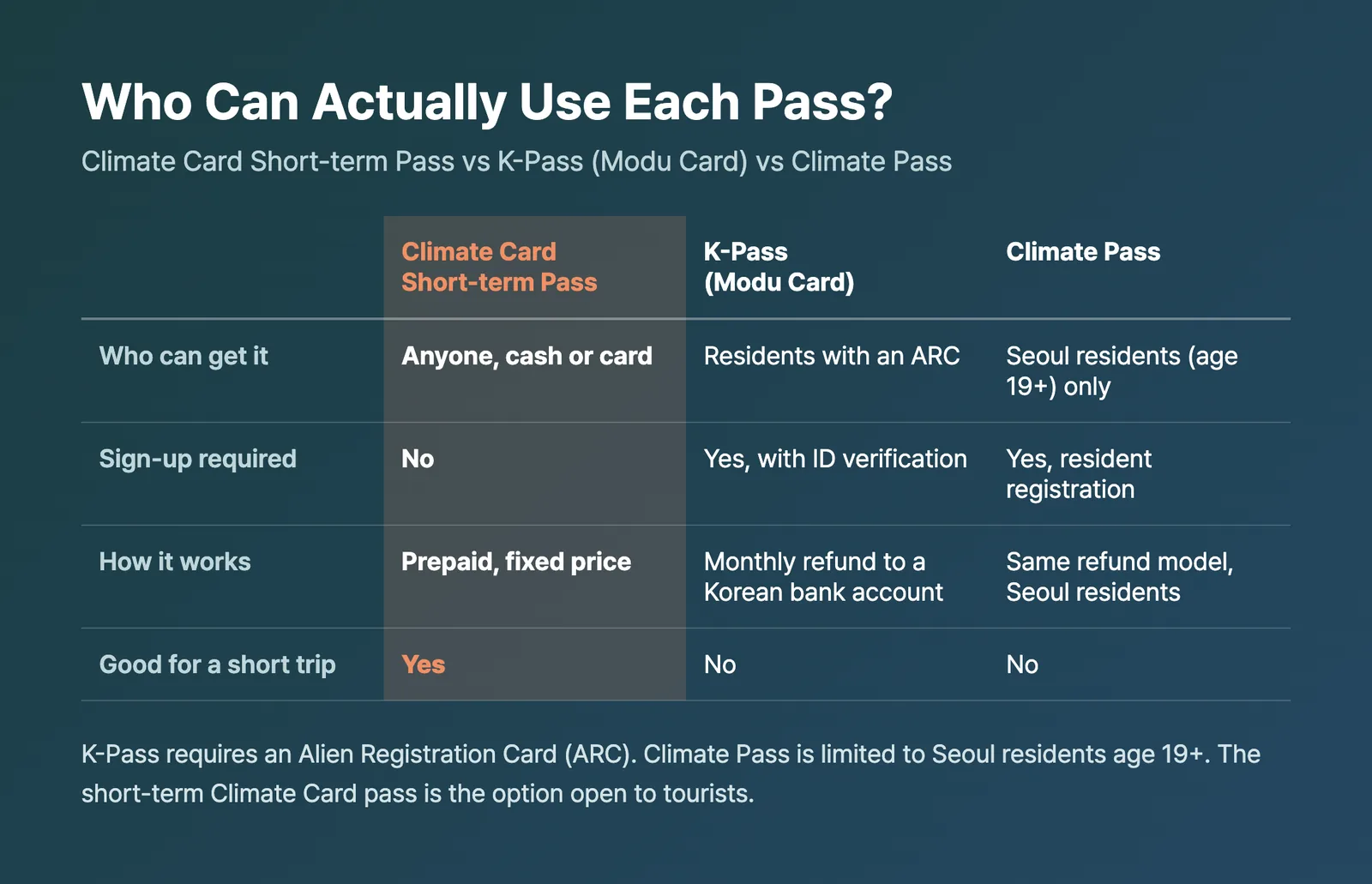
You’ll see two other names floating around: K-Pass (“Modu Card”) and the new Climate Pass (Seoul’s replacement for the 30-day Climate Card, sometimes called “Climate Card Plus” in English press materials). Neither one is a realistic option for a short trip, and here’s exactly why, straight from the official eligibility pages.
K-Pass / Modu Card: the official sign-up page limits eligibility to residents of a participating municipality, and registration requires setting up an account with identity verification. Seoul’s own English site adds that you can only sign up for an account if you have a foreigner registration number, meaning you need an Alien Registration Card (ARC), something short-term visitors don’t have.
Climate Pass: Seoul’s launch notice (updated Sep 18, 2026) is even more direct: eligibility is limited to citizens age 19 and up whose registered residential address is in Seoul. It’s also structurally different from the old Climate Card: instead of a simple prepaid pass, it’s a monthly-spend program that refunds a percentage after the fact (roughly 20% back, or the portion of spending over KRW 62,000 a month), which requires a Korean bank account to receive the refund.
| Climate Card Short-term Pass | K-Pass (Modu Card) | Climate Pass | |
|---|---|---|---|
| Who can get it | Anyone, cash or card | Residents with an ARC | Seoul residents (age 19+) only |
| Sign-up required | No | Yes, with ID verification | Yes, resident registration |
| How it works | Prepaid, fixed price | Monthly refund to a Korean bank account | Same refund model, Seoul residents |
| Good for a short trip | Yes | No | No |
Bottom line for tourists: of the three, the short-term Climate Card pass is still the only one you can actually walk up and buy today.
4. Climate Card Short-Term Pass Prices and Is It Worth It?

Source: Seoul Metropolitan Government (english.seoul.go.kr), captured 2026-09-30
Prices haven’t changed. Here’s the full official breakdown:
| Pass | Price |
|---|---|
| 1-day | KRW 5,000 |
| 2-day | KRW 8,000 |
| 3-day | KRW 10,000 |
| 5-day | KRW 15,000 |
| 7-day | KRW 20,000 |
| Youth 7-day (from Sep 1, 2026) | KRW 13,000 (requires youth verification through Tmoney’s website; whether visiting tourists can complete that verification is unconfirmed) |
| Physical card | KRW 3,000, charged separately, non-refundable |
Note that these passes aren’t a flat 24 hours. The clock starts the moment you charge the card and runs until the last train or bus of the final day, so you can’t pre-load a pass to start later. Charging a 1-day pass at 9 p.m. wastes most of its value, so try to buy it first thing in the morning of the day you’ll actually use it.
Is it actually cheaper than paying per ride?
Here’s the math, assuming a standard adult subway fare of KRW 1,550 per journey, every trip staying under 10 km, and any transfer within 30 minutes counting as a single fare (distance surcharges and the early-bird discount aren’t factored in):
| Pass | Price | Rides needed to break even |
|---|---|---|
| 1-day | KRW 5,000 | 4 rides |
| 2-day | KRW 8,000 | 6 rides |
| 3-day | KRW 10,000 | 7 rides |
| 5-day | KRW 15,000 | 10 rides |
| 7-day | KRW 20,000 | 13 rides |
That’s the version excluding the KRW 3,000 card cost, which is fair if you’d be buying some kind of transit card anyway. If you count the non-refundable card fee in, the break-even point moves higher:
| Pass | Price + card fee | Rides needed to break even |
|---|---|---|
| 1-day | KRW 8,000 | 6 rides |
| 2-day | KRW 11,000 | 8 rides |
| 3-day | KRW 13,000 | 9 rides |
| 5-day | KRW 18,000 | 12 rides |
| 7-day | KRW 23,000 | 15 rides |
And if you’re paying at a subway kiosk with a foreign card (average 3.7% service fee, see section 5), a 1-day pass costs about KRW 5,185 (still roughly 4 rides to break even) and a 7-day pass costs about KRW 20,740 (about 14 rides, one more than the base scenario).
In plain terms: a 1-day pass only pays off if you’re genuinely hopping on and off four-plus times in one day. The 3-, 5- and 7-day passes are much more forgiving, roughly two rides a day (subway to a sight, back to your hotel) is usually enough to come out ahead, especially on longer rides like Gangnam to Hongdae that would otherwise rack up distance surcharges on regular T-money.
👉 Check Official Prices and Coverage on Seoul’s Site
How It Compares: T-money, WOWPASS, and Discover Seoul Pass
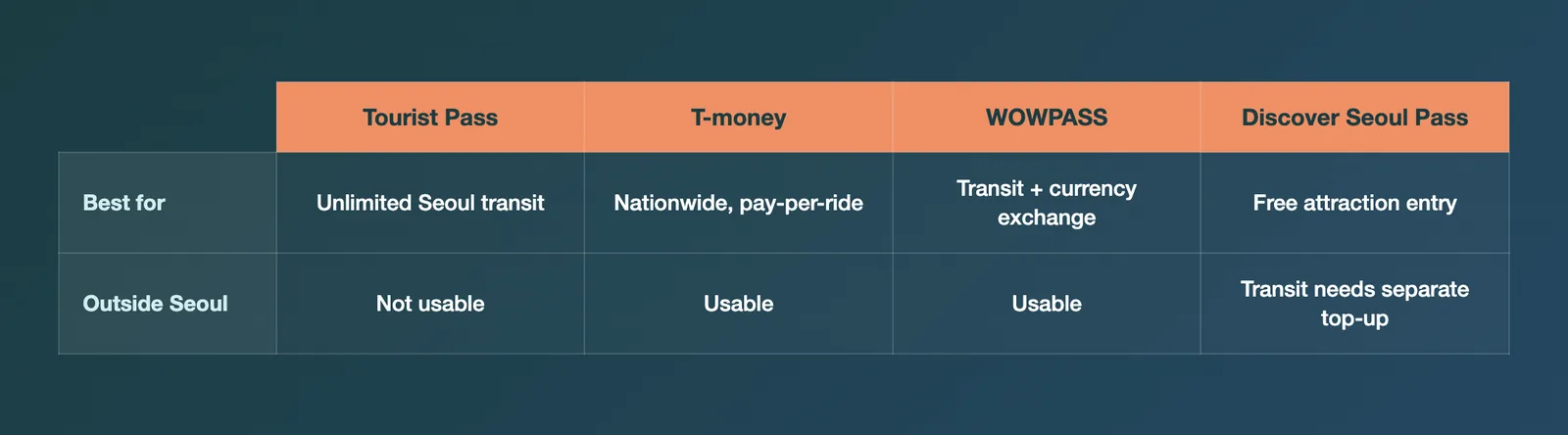
| Tourist Pass (Climate Card) | T-money | WOWPASS | Discover Seoul Pass (DSP) | |
|---|---|---|---|---|
| What it’s for | Unlimited transit within Seoul | Nationwide, pay-per-ride | All-in-one transit + currency exchange + payment | Mainly free entry to attractions |
| Pricing structure | Flat rate, unlimited (1-7 days) | Prepaid, deducted per ride | Prepaid, deducted per ride | Sold in 24/48/72-hour blocks |
| Travel outside Seoul | Not usable (Sinbundang Line and more excluded) | Works nationwide (Busan, Jeju, etc.) | Works nationwide | Transit runs on T-money, needs separate top-up |
| Best for | 4+ transit rides a day, plus 50% off select Seoul cultural facilities | Flexibility to use it anywhere | Currency exchange plus instant app-based lock if lost | Visiting 2-3+ paid attractions a day |
This comparison draws on travel community and travel blog sources beyond Seoul’s official materials, so exact figures may shift over time.
✅ Which one fits your trip?
- Staying in Seoul and taking transit 4+ times a day → Tourist Pass
- Heading outside Seoul too, like Busan or Jeju → T-money
- Want currency exchange plus a safety net if you lose your card → WOWPASS
- Planning to hit 2-3+ paid attractions in a single day → Discover Seoul Pass
The Tourist Pass does have real downsides. The 1-day option isn’t a 24-hour pass, it’s valid only until the last train on the day you top it up, so loading it late in the evening is a poor deal. Bike-share and the river bus aren’t included by default, and since it only comes as a physical card, losing it means going through a somewhat tedious reissue and refund process.
5. How to Buy and Recharge a Climate Card Short-Term Pass
Where to buy the physical card
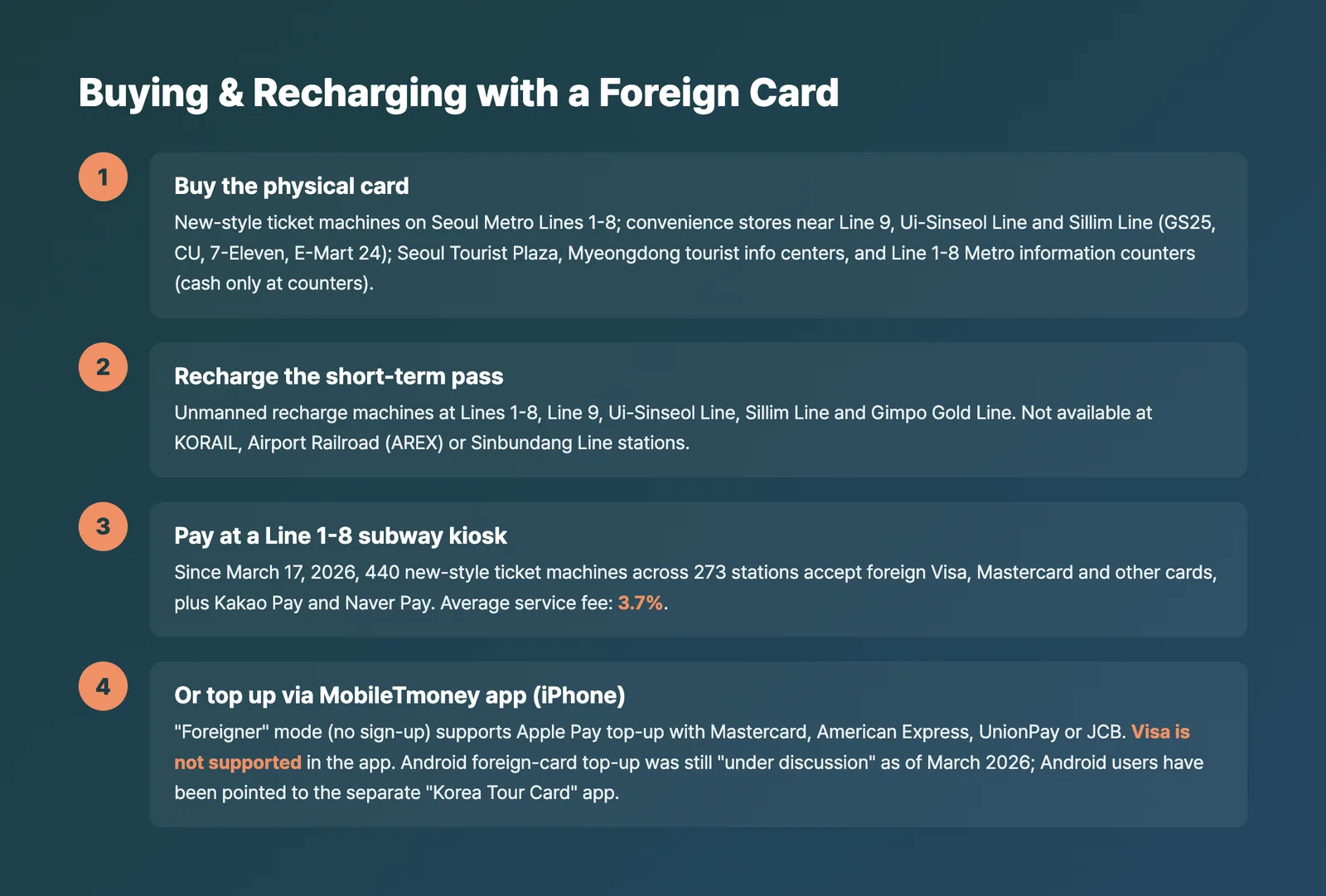
- New-style ticket machines inside Seoul Metro Lines 1-8 stations
- Convenience stores near Line 9, Ui-Sinseol Line and Sillim Line stations (GS25, CU, 7-Eleven, E-Mart 24)
- Seoul Tourist Plaza and Myeongdong tourist information centers, and Line 1-8 Seoul Metro information counters (cash only at these counters)
- ⚠️ Not confirmed: an official Climate Card sales point inside Incheon Airport itself. The airport railway (AREX) stations at T1/T2 aren’t rechargeable stops either, so plan to arrive with T-money or cash and pick up a Climate Card once you’re properly in Seoul.
Where to recharge
Unmanned recharge machines inside Seoul Metro (Lines 1-8), Line 9, Ui-Sinseol Line, Sillim Line and Gimpo Gold Line stations. You cannot recharge at KORAIL, Airport Railroad (AREX) or Sinbundang Line stations.
Paying with a foreign card
Since March 17, 2026, the 440 new-style ticket machines across 273 stations on Lines 1-8 accept internationally issued Visa, Mastercard and other cards, plus Kakao Pay and Naver Pay, for buying a Climate Card, recharging a short-term pass, and buying single-journey tickets. Seoul’s press release is explicit that this averages a 3.7% service fee. Whether these same machines let you top up an ordinary (non-Climate Card) T-money balance with a foreign card isn’t stated in the official release, so don’t assume it works for a plain T-money card.
For iPhone users, the MobileTmoney app added a “Foreigner” mode (no sign-up required) that lets you top up through Apple Pay using Mastercard, American Express, UnionPay or JCB. Note that Visa is not supported in the app. Android support for foreign-card top-ups was still described as “under discussion” as of the app’s March 2026 update, with no confirmed change since; Android users have historically been pointed to a separate app, “Korea Tour Card,” instead.
⚠️ Two things worth flagging in the city’s own materials: Seoul’s English-language Climate Card page still lists “March 20, 2025” as the launch date for foreign-card payment, while Seoul’s official press release and multiple 2026 news reports date the actual launch to March 17, 2026, a discrepancy inside the city’s own site that we couldn’t resolve. Separately, the Korea Tourism Organization’s VisitKorea page states that card purchase and charging can only be done with cash or a Korea-issued card, which directly conflicts with Seoul’s own announcement that foreign-issued cards work at the new kiosks. We’re going with Seoul’s press release and the 2026 news coverage, since they’re more specific and more recent, but if a kiosk seems to reject your card, don’t assume it’s user error, try a different machine or keep cash as backup.
✅ Quick checklist before you buy
- Confirm your route stays inside Seoul city limits, not Gimpo, Gwacheon, or the other excluded areas
- Bring a Mastercard, AMEX, UnionPay or JCB if you plan to use the iPhone Tmoney app (Visa won’t work there)
- Any major card should work at the Line 1-8 subway kiosks (expect an average 3.7% fee)
- Charge your pass the morning you plan to use it, not the night before
- Keep backup cash or a regular T-money card for Incheon Airport and any excluded areas
💡 Quick tip: if your only card is Visa, plan on the subway kiosk route rather than the iPhone app, since the app skips Visa entirely.
Tag in and tag out on every ride
Tapping in and out is required on every subway and bus ride, even though the pass is unlimited. Forgetting to tag out triggers a penalty, and after two missed tag-outs your card is suspended for 24 hours starting from your last ride.
Getting a refund before your pass ends
If your plans change, scan your card at an unmanned top-up machine inside any subway station before the pass period ends and select the refund/suspend option. Then take your card and passport to the T-Town customer service center on the 1st floor of Seoul City Tower. Refunds are paid in cash within 3 business days, calculated as your loaded amount minus what you’ve already used and a ₩500 refund fee.
Using it for Ttareungyi bike-share (optional)
Bike-share isn’t included automatically. To use Seoul’s Ttareungyi bikes, register your card on the Tmoney Card & Pay website, then enter the 16-digit number starting with 1032 (printed on the back of the card) in the Tmoney GO app. You’ll need to wait one hour after topping up before registration works.
6. Can You Tap Your Own Foreign Card on Seoul Transit? Not Yet
Open-loop payment, tapping your own contactless Visa or Mastercard directly on the turnstile or bus reader, the way you might in London or Singapore, is not available in Seoul as of September 30, 2026.
According to The Korea Herald (Sep 18, 2026), Tmoney plans to launch this on Seoul city buses in 2027, followed by Incheon buses and airport buses, with Tmoney having signed agreements with Visa, Mastercard, UnionPay, JCB and Hana Card. Yonhap (Sep 22, 2026) reports Hana Card specifically targeting a January 2027 rollout, starting with Seoul city buses and later expanding to Incheon buses, airport buses, rail operators and town buses. Seoul’s own roadmap, from an October 2025 announcement, lists subway Lines 1-8 as a 2027 target too, with full expansion to town buses and private railways planned for 2028 to 2030.
For a trip in late 2026, this still means: no tap-and-go with your own bank card. You’ll need a Climate Card, T-money, or single-journey tickets.
7. Already Have an Old Climate Card From a Previous Trip?
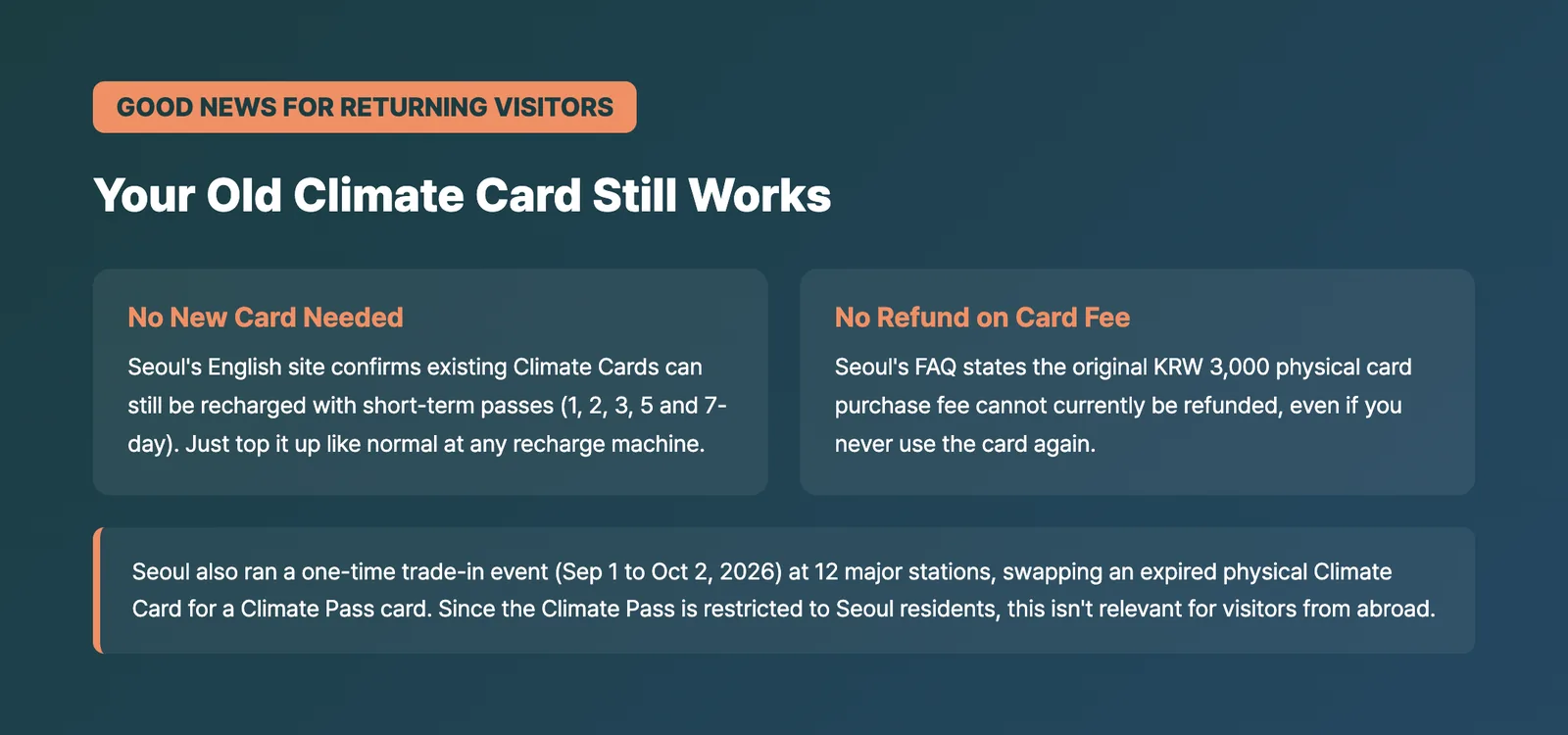
Good news if you picked one up on an earlier visit: you don’t need to buy a new card. Seoul’s English site confirms that existing Climate Cards can still be recharged with short-term passes (1-, 2-, 3-, 5- and 7-day). Just top it up like normal at any recharge machine.
One thing that won’t happen: a refund of the original KRW 3,000 card purchase fee. Seoul’s FAQ states plainly that refunding the physical card’s purchase price isn’t currently possible, so don’t expect that money back even if you never use the card again.
Seoul also ran a one-time trade-in event (Sep 1 to Oct 2, 2026) letting people swap an expired physical Climate Card for a Climate Pass card at 12 major stations, but since the Climate Pass itself is restricted to Seoul residents, this isn’t really relevant if you’re visiting from abroad.
8. FAQ: Climate Card Questions Tourists Ask
Q1. Is the Seoul Climate Card being discontinued?
A. Only partly. The 30-day pass (prepaid and postpaid) ends October 1, 2026. The 1-, 2-, 3-, 5- and 7-day short-term passes that tourists actually use are staying on sale.
Q2. What changed for tourists specifically on October 1, 2026?
A. The area where a short-term pass works shrank to Seoul city limits plus exit-only access at Incheon Airport T1/T2. Gimpo, Goyang, Gwacheon, Guri, Seongnam, Hanam and Namyangju are excluded going forward.
Q3. Should I get K-Pass or the Climate Pass instead?
A. No, not as a short-term visitor. Both require Korean residency documentation, an Alien Registration Number for K-Pass, Seoul resident registration for the Climate Pass. The short-term Climate Card pass remains the option actually open to tourists.
Q4. Can I just tap my own credit card at the turnstile?
A. Not yet. Open-loop tap payment isn’t live as of this writing; Tmoney and Hana Card both point to 2027 for a bus-first rollout.
Q5. Can I pay for a Climate Card with my Visa or Mastercard?
A. At subway ticket machines on Lines 1-8, yes, foreign Visa, Mastercard and similar cards work, with an average 3.7% service fee. In the MobileTmoney iPhone app, yes for Mastercard, AMEX, UnionPay or JCB, but not Visa.
Q6. Does the short-term pass work getting into Seoul from Incheon Airport?
A. Only for exiting, not boarding. You can tap out at T1/T2 with a short-term pass, but you can’t board the airport train there, so you’ll need T-money or a ticket for that leg.
Q7. I still have a Climate Card from a past trip. Can I reuse it?
A. Yes. Just recharge it with a short-term pass like normal. You won’t get the original KRW 3,000 card fee refunded, but the card itself keeps working.
Q8. Is there a mobile app version of the tourist pass?
A. No. The short-term pass for visitors only comes as a physical card. Setting up a mobile Climate Card requires a Korean resident registration number or alien registration number, which most short-term tourists don’t have.
Q9. What happens if I forget to tag out?
A. You’ll be charged a penalty, and after two missed tag-outs the card is suspended for 24 hours from your last ride. Make tagging out a habit.
Q10. Can I pay with JCB or Amex at the new kiosks?
A. Seoul’s official announcement only mentions “Visa, Mastercard and similar cards.” JCB and Amex support has only appeared in a few travel blogs, not in an official source, so a Visa or Mastercard is the safest bet at the kiosks. (The iPhone MobileTmoney app is different: it supports Mastercard, Amex, UnionPay and JCB, but not Visa.)
The Bottom Line
The headline “Climate Card is ending” is technically true and mostly irrelevant to you. What actually matters for a Seoul trip in late 2026 is this: short-term passes are still on sale, prices haven’t moved, but the area they cover just got smaller.
Quick recap:
- 30-day pass (prepaid/postpaid): gone as of Oct 1, 2026. Short-term 1/2/3/5/7-day passes: still available.
- From Oct 1, short-term passes only cover Seoul city plus exit-only access at Incheon Airport, no more Gimpo, Goyang, Gwacheon, Guri, Seongnam, Hanam or Namyangju.
- K-Pass and the Climate Pass both require Korean residency proof, skip them as a visitor.
- Prices run KRW 5,000 to 20,000 depending on pass length, plus a non-refundable KRW 3,000 card.
- Foreign cards work at subway kiosks (3.7% fee) and in the iPhone Tmoney app (not Visa), but tapping your own card is still 2027 at the earliest.
Plan your route around Seoul proper, keep a backup T-money option for anything outside that zone, and you’ll be fine.
👉 See Tmoney’s Full Foreigner Guide for the Climate Card
Related guides
- WOWPASS vs NAMANE Card: Which Prepaid Card for Korea? (2026)
- Naver Map in English: Why Google Maps Fails in Korea (2026 Guide)
- Korea e-Arrival Card 2026: How to Apply, Validity, and Exemptions
Sources
- Seoul Climate Card (30-day pass) shutdown FAQ
- Seoul Climate Card short-term pass business overview
- Seoul Metropolitan Government (English): Climate Card
- Seoul press release: foreign card payment at subway ticket machines (Mar 16, 2026)
- Seoul press release: Climate Pass launch and card exchange event (Aug 27, 2026)
- Naeson Seoul (내 손안에 서울) Q&A on the Climate Pass changes (Aug 12, 2026)
- Seoul public transit fare guide
- Seoul open-loop payment announcement
- Tmoney Climate Card user guide for foreigners
- Tmoney Foreigner Guide (T-money top-up/refund)
- Korea Tourism Organization: Transportation Cards
- K-Pass official eligibility page
- The Korea Herald: Foreign cards to work on Seoul buses from 2027
- Yonhap: Hana Card open-loop transit service
- Seoul Metropolitan Government, “Seoul launches Climate Card Tourist Pass with 1, 2, 3 and 5-day options”: https://english.seoul.go.kr/seoul-launches-climate-card-tourist-pass-with-1-2-3-and-5-day-options-starting-in-july
- Seoul Metropolitan Government, “Climate Cards and single-journey transit tickets now accepting international credit cards”: https://english.seoul.go.kr/climate-cards-and-single-journey-transit-tickets-now-accepting-international-credit-cards-no-cash-needed/
- Visit Seoul, “Notice: Climate Card top-up via overseas credit/debit cards”: https://english.visitseoul.net/announcements/Notice-Climate-Card-Top-up-via-Overseas-CreditDebit-Cards-/ENB014088
- Kyunghyang Shinmun (2026-03-16): https://www.khan.co.kr/article/202603161115001
- r/koreatravel, “Comparing transit cards: T-money, EZL and more” (community discussion): https://www.reddit.com/r/koreatravel/comments/1oaj5b5/comparing_transit_cards_pros_and_cons_tmoney_ezl/