Korea e-Arrival Card 2026: How to Apply, Validity, and Exemptions
“Should I tell my foreign friend who’s visiting Korea that they absolutely need to submit an e-Arrival Card?”
You may have heard that Korea’s entry procedures are changing significantly starting in 2026. The problem is, it’s hard to find one clear article that covers who needs to apply, when, and how. It’s also easy to get confused about whether you can still use the paper form, and how this differs from K-ETA.
Don’t worry: this single guide covers everything you need to know about the e-Arrival Card, including how to apply, the validity period, and who is exempt.
1. What Is the e-Arrival Card?
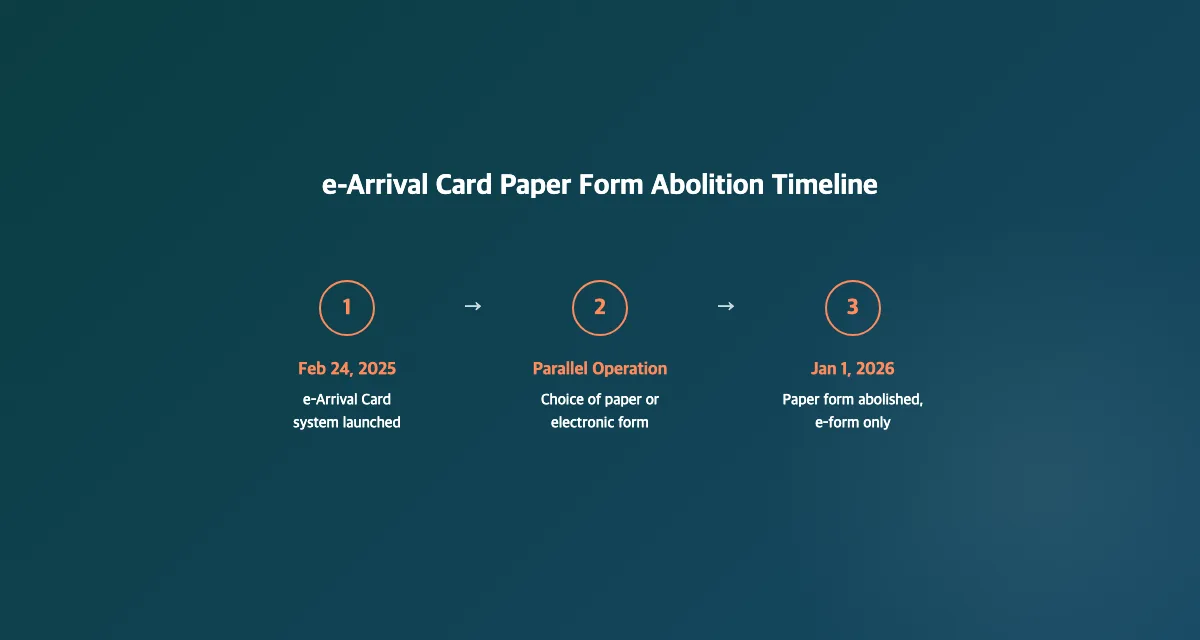
To cut straight to it: the e-Arrival Card is an online arrival declaration system created by South Korea’s Ministry of Justice (Korea Immigration Service). Instead of filling out a paper arrival card, foreign travelers submit their entry information online.
The Ministry of Justice launched this system on February 24, 2025. At first, it ran as a parallel operation period, during which travelers could choose between the paper form and the electronic form.
That parallel period was originally expected to end with 2025, and many travel sites reported that paper cards were abolished from January 1, 2026. That isn’t quite right. Korea’s Ministry of Justice has said it will keep accepting both paper and electronic arrival cards until it officially announces the end of the paper form, and the official e-Arrival Card guide still lists “electronic/paper arrival card” as a choice (checked October 2026). Submitting online in advance is still the faster, recommended option, and it applies to most short-term foreign visitors, including tourists and business travelers.
⚠️ Note: The e-Arrival Card is not a travel authorization (K-ETA). It does not replace your visa or visa-free entry eligibility. It is simply a declaration form that replaces the old paper arrival card.
2. How to Apply: 5 Steps, Done in About 5 Minutes
The official website is www.e-arrivalcard.go.kr. It supports multiple languages, including English, Chinese, and Japanese.
You can apply starting 3 days before your arrival date, based on Korea Standard Time (KST). For example, if you’re arriving on July 31, you can submit your form anytime on July 29, 30, or 31.
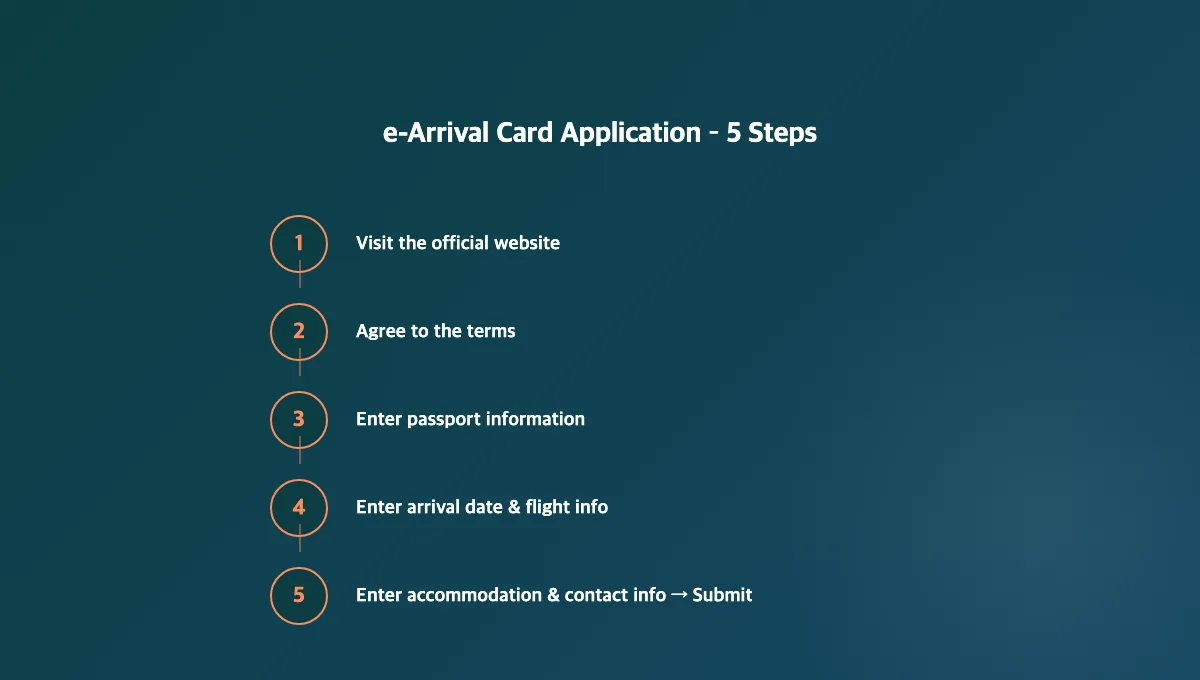
Application Steps
- Go to the official website
- Agree to the terms and conditions
- Enter your passport information
- Enter your arrival date and flight information
- Enter your accommodation and contact information → Submit
The whole process is said to take about 5 minutes.
What you’ll need
- Passport (biographic data page)
- A valid email address
- Arrival date and flight number
- Accommodation address and contact information
- Purpose of visit
- Departure date and flight (optional)
💡 Tip: On a PC, you can submit for up to 1,000 people at once in a batch, while on mobile you can submit for up to 9 people. If you’re traveling with family or a group, submitting from a PC is much more convenient.
3. It’s Free! Paid Sites Are Scams
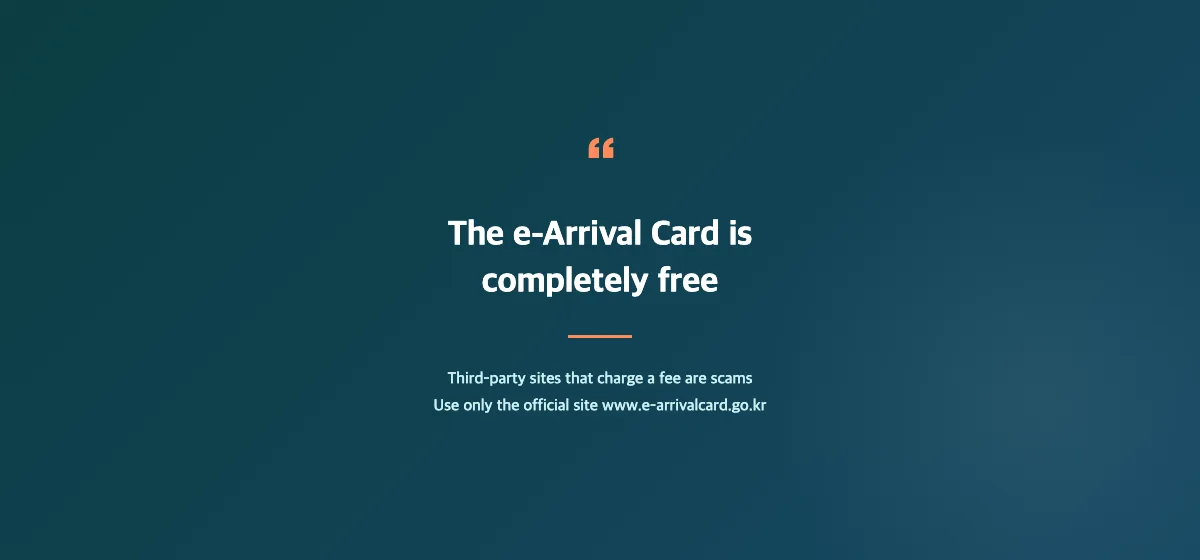
The e-Arrival Card is completely free. The official site itself states clearly, “There is no fee for South Korea’s e-Arrival Card.”
Never use a third-party site that asks you to pay! If any site other than the official one asks for a fee or payment, it’s very likely a scam.
✅ What to do: Before you apply, double-check that the address bar shows exactly www.e-arrivalcard.go.kr.
👉 Apply for free on the official e-Arrival Card website
4. 72-Hour Validity: Know the Resubmission Rules
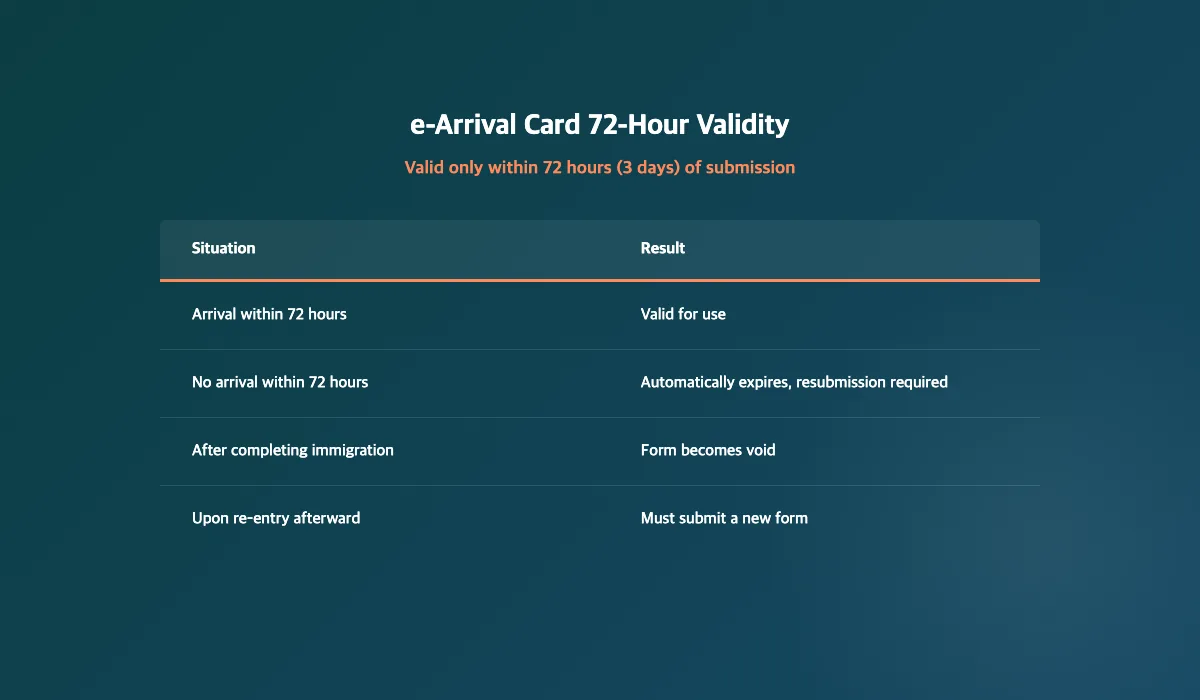
Once submitted, your e-Arrival Card is valid for only 72 hours (3 days) from the time of submission.
| Situation | Result |
|---|---|
| You enter Korea within 72 hours | It’s valid and can be used normally |
| You don’t enter Korea within 72 hours | It automatically expires, and you must resubmit |
| After you’ve completed immigration inspection | The declaration becomes void |
| If you re-enter Korea later | You must submit a new form |
If your schedule changes and your arrival is delayed, don’t try to hang on to your old submission. It’s safer to simply submit a new one.
5. Check If You’re Exempt: Do I Really Need to Submit One?
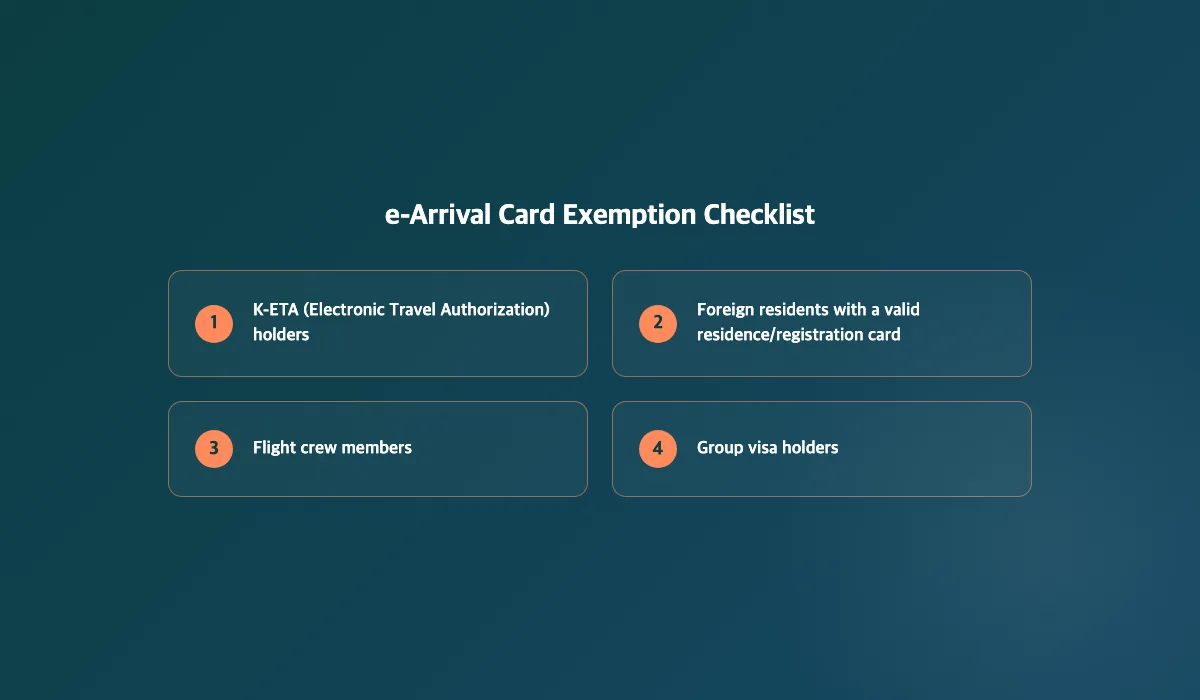
You are not required to submit an e-Arrival Card if you fall into any of the following categories:
- [ ] Holders of a K-ETA (Korea Electronic Travel Authorization)
- [ ] Foreign residents holding a valid Domestic Residence Report Certificate or Alien Registration Card
- [ ] Aircraft crew members
- [ ] Holders of a group visa
That said, these four categories are simply the ones confirmed consistently across several official and travel-information sources, and this is not a complete list of every visa-specific exception. If your situation is unclear, it’s safest to double-check with the official guide.
6. How Is This Different From K-ETA? Clearing Up Two Confusing Systems
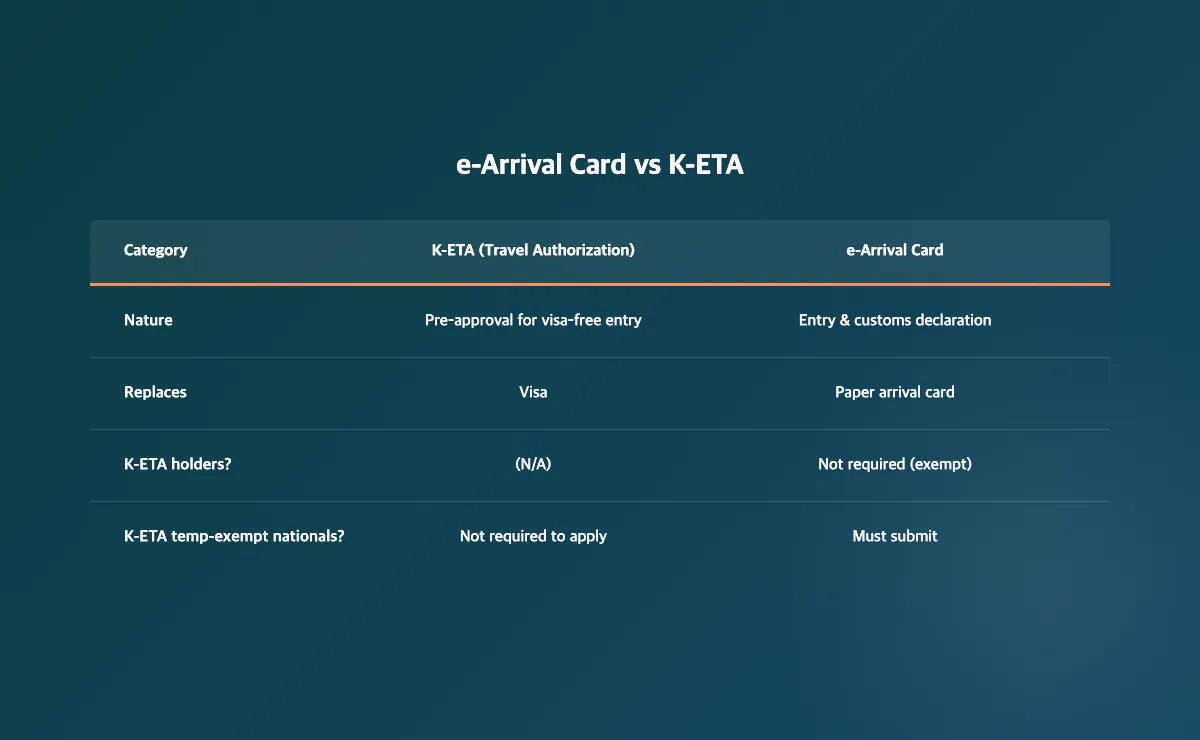
The e-Arrival Card and K-ETA (Electronic Travel Authorization) are two separate systems.
| Category | K-ETA (Electronic Travel Authorization) | e-Arrival Card |
|---|---|---|
| What it is | Advance approval of visa-free entry eligibility | Entry/customs declaration form |
| What it replaces | A visa | The paper arrival card |
| If you hold a K-ETA | (not applicable) | No submission required (exempt) |
| If you’re a national of a K-ETA temporary-exemption country | No application needed | Submission is mandatory |
In other words, if you already hold a K-ETA, you don’t need to also submit an e-Arrival Card. However, if you’re exempt from K-ETA (for example, as a national of a temporarily exempted country), you must still submit an e-Arrival Card.
South Korea’s Ministry of Justice has extended the K-ETA temporary exemption through December 31, 2026. Countries covered by the exemption include Australia, Canada, France, Germany, Italy, Japan, Singapore, Spain, the United Kingdom, and the United States, among others.
💡 Note: If you’re a national of one of the exempt countries listed above, you don’t need to apply for K-ETA itself, but remember that you must still submit an e-Arrival Card.
7. Why Is the Whole World Switching to Electronic Arrival Cards?
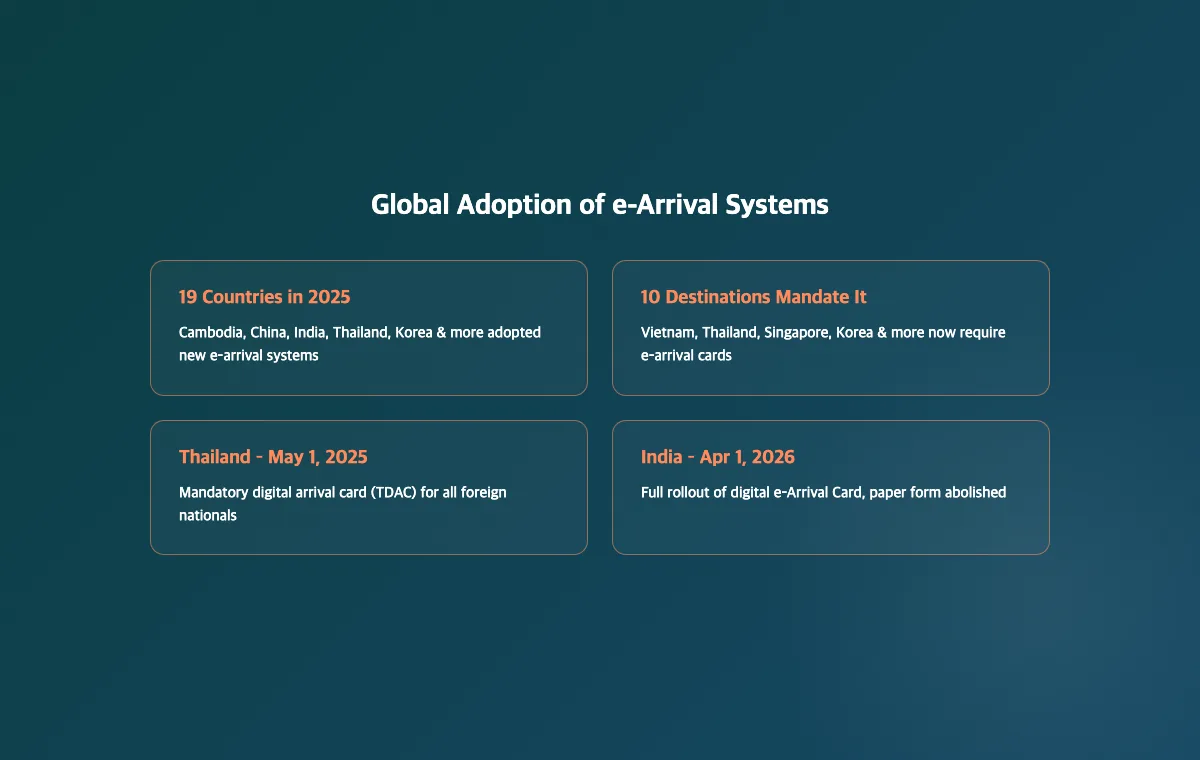
This isn’t a change unique to Korea. There’s a clear global trend of replacing paper arrival cards with electronic declaration systems.
- According to the iVisa blog, 19 countries and territories introduced new e-Arrival Card systems in 2025 alone, including Cambodia, China, India, Indonesia, Taiwan, Thailand, and South Korea.
- 10 destinations (Vietnam, Thailand, Singapore, Malaysia, India, the Philippines, Korea, Taiwan, Indonesia, and China) now require an e-Arrival Card, and New Zealand, Cambodia, and Australia are preparing to make the switch as well.
- Thailand made its digital arrival card (TDAC) mandatory for all foreign nationals, regardless of nationality or visa type, starting May 1, 2025.
- India fully mandated the digital e-Arrival Card and abolished the paper arrival form starting April 1, 2026.
Behind this shift is a UN Tourism statistic showing that international tourist arrivals worldwide hit a record high of 1.52 billion in 2025. Governments are responding to this growing travel demand by automating and front-loading their border-processing procedures.
As more and more countries adopt these systems, some in the travel industry say that searches for “e-arrival card” have been increasing compared to before. However, this research did not turn up reliable statistics confirming an exact search-volume increase, so it’s difficult to state a specific figure with certainty.
⚠️ Note: Submitting an e-Arrival Card with false information is a violation of Korean law and can result in criminal penalties or entry restrictions. This applies equally whether you submit it yourself or have it submitted on your behalf by a family member, travel agency, or other third party.
8. Frequently Asked Questions (FAQ)
Q1. If I already have a K-ETA, do I still need to submit an e-Arrival Card?
A. No. If you’ve already been issued a valid K-ETA, you don’t need to separately submit an e-Arrival Card.
Q2. When can I apply?
A. You can apply starting 3 days before your arrival date, based on KST. Don’t apply too early. A few days before departure is the right time.
Q3. What happens if the validity period expires?
A. Your submission automatically expires 72 hours (3 days) after you submitted it. If that happens, you’ll need to submit a new one.
Q4. What happens if I enter false information?
A. You could face criminal penalties or entry restrictions. This applies whether you submit it yourself or someone submits it on your behalf, so make sure to enter accurate information.
Conclusion: Skip the Paper Form and File in 5 Minutes on Your Phone
Paper cards are being phased out and the airports now push travelers toward the online form, so if you sort out the e-Arrival Card ahead of time, the entry process actually becomes even simpler.
✅ 4 Key Things to Remember
- Starting January 1, 2026, the paper arrival card is abolished, and the e-Arrival Card becomes the only method
- You can apply starting 3 days before arrival, it takes about 5 minutes, and it’s completely free
- Your submission is valid only if you enter Korea within 72 hours; otherwise, you must resubmit
- K-ETA holders and others are exempt. Check which category applies to you first
Be sure to share this information with any foreign friends or family members planning to visit Korea. Wishing you a safe and enjoyable trip to Korea!
Related guides
- Korea eSIM Guide: Which Network Are You Really Buying?
- Seoul Climate Card Tourist Pass 2026: What Changed and What to Buy
- Korea Tax Refund Guide: How to Get Your VAT Back
Sources and References
- Official Korea e-Arrival Card Guide (e-arrivalcard.go.kr): https://www.e-arrivalcard.go.kr/portal/guide/eacGuide.do
- Korea Immigration Service, Ministry of Justice, English press release: https://www.immigration.go.kr/immigration_eng/1832/subview.do?enc=Z…
- Korea Ministry of Justice K-ETA Information Page: https://www.immigration.go.kr/immigration/3339/subview.do
- KPMG, “South Korea – Extension of Temporary K-ETA Exemption for Eligible Nationals”: https://kpmg.com/xx/en/our-insights/gms-flash-alert/2026/flash-aler…
- iVisa Blog, “Countries that require arrival cards in 2026”: https://www.ivisa.com/blog/countries-that-require-arrival-cards-in-…
- EXO Travel Blog, “Korea Extends K-ETA Exemption and Introduces Mandatory Digital e-Arrival Card”: https://www.exotravel.com/blog/korea-arrival-card-keta/
- K-ETA official portal, “Notice on Extension of K-ETA Temporary Exemption” (2025-12-23): https://www.k-eta.go.kr/portal/board/viewboarddetail.do?bbsSn=299707
- VisasNews, “South Korea: paper arrival card still accepted despite rollout of the e-Arrival Card” (2026-03-13, citing the Ministry of Justice e-Arrival Card service): https://visasnews.com/en/south-korea-paper-arrival-card-still-accepted-despite-rollout-of-the-e-arrival-card/
📌 If you found this guide helpful, please save and share it!