
DMZ Tour from Seoul 2026: What’s Open, Prices, Tour vs Going Solo
Last checked: November 2, 2026 · How I check facts
This post contains affiliate links. If you book through them, we may earn a small commission at no extra cost to you.
Quick answer: You can still do a DMZ tour from Seoul in November 2026, but not the JSA: Panmunjom is closed to foreign visitors. The Third Tunnel and Dora Observatory are open, either on a group tour (about ₩60,000 to ₩67,000) or on Paju City's own shuttle from Imjingak (₩9,200 or ₩12,200) with your physical passport.
Heads-up for November 23 to 30, 2026: Paju City has suspended visits to Dora Observatory for repair work on its access road from Monday, November 23 to Monday, November 30, 2026, and says the work may be extended. The Third Tunnel stays open, and in this period tickets are sold on site only. Notice posted October 23, 2026.
I checked every stop on November 2, 2026, using Korean government pages first: Paju City's DMZ Peace Tourism site (Korean and English), the Ministry of Unification's Panmunjom tour center, and the operators' own pages. US dollar figures use about ₩1,325 = US$1 (the late October 2026 rate). Where sources disagree or I couldn't confirm something, I say so.
Many English guides say you can't visit the DMZ without a tour. That's not true. A tour is a convenience, not a requirement, so this guide covers both routes.
In this guide: jump to a section
- What’s open at the DMZ in November 2026?
- Is the JSA (Panmunjom) open to foreign visitors?
- Can you visit the DMZ from Seoul without a tour?
- How to visit the DMZ on your own, step by step
- What does an organized DMZ tour from Seoul include, and what does it cost?
- DMZ tour vs going solo: which should you choose?
- DMZ rules: what applies to everyone, and what’s JSA-only
- Other DMZ spots near Seoul
- What changed from 2024 to 2026, and when the DMZ closes without warning
- FAQ
- Quick checklist
What's open at the DMZ in November 2026?
A Korea DMZ tour usually means a short loop just south of the demilitarized zone in Paju, north of Seoul. Status as of November 2, 2026:

- Imjingak park: open, free, no booking or ID. It's outside the Civilian Control Line.
- Third Tunnel (제3땅굴): open, by Paju shuttle or tour, passport required. Its monorail resumed on September 29, 2026.
- Dora Observatory (도라전망대): open, except November 23 to 30, 2026. The rooftop reopened in August 2025.
- Imjingak Peace Gondola: open daily.
- Odusan Unification Observatory: open, closed Mondays.
- Panmunjom / JSA: closed to foreign visitors since July 18, 2023.
- DMZ Peace Trail: Korean nationals only.
- Paju's Dorasan shuttle train: ended in March 2026.
Is the JSA (Panmunjom) open to foreign visitors?
No. As of November 2, 2026, the Ministry of Unification's application page says (my translation): "Currently, group (organization) and foreign visitor tours are not operated." Its Panmunjom tour center shows "no tours" (견학없음) on every date of the November 2026 calendar.
How it got here:
- July 18, 2023: tours stopped after a US soldier on a tour crossed into North Korea. Special tours briefly restarted on November 22, 2023, then stopped again on December 1.
- May 16, 2025: "special tours" restarted, but only for selected public officials and trainees, in smaller groups. The ministry said general public tours were not being considered.
- 2025 total: a Korean newspaper reported on October 28, 2026 that special tours ran 22 times in 2025, for 341 people.
VisitKorea's English page agrees: "Panmunjeom is currently closed for civilian tours" (updated October 30, 2025). English blogs that describe bookable JSA slots are out of date.
What "JSA" means in a tour name today
You'll still see "JSA" in DMZ tour titles. It usually means a "JSA Museum," a private exhibition on some VIP Travel tours, or a "JSA Photo Zone," which one seller called "newly opened" in October 2026 (I couldn't confirm where it is or who runs it). Neither is Panmunjom. Another listing for the same VIP Travel tour states that the JSA "is currently closed to visitors."
Can you visit the DMZ from Seoul without a tour?
Yes. Paju City runs its own DMZ Peace Tourism program (DMZ 평화관광) from Imjingak, and anyone with valid ID can join. Private cars can't enter the Civilian Control Line, so you ride in on Paju's shuttle bus.
The course takes about 3 hours: Imjingak, the Third Tunnel, Dora Observatory, Unification Village (통일촌, Tongilchon), then back to Imjingak. Some departures do the observatory first. Dorasan Station is not on the individual shuttle course as of November 2026.
The trade-off: Paju's site says the program has no tour guide. You get the tunnel's video room and the signs on site. In return, it's far cheaper and you set your own pace at Imjingak.
How to visit the DMZ on your own, step by step
Step 1: Book online (or plan to queue)
Paju has an English booking page. When I went through it on November 2, 2026 (up to the payment step, without paying), it asked for:
- Date, course (Tunnel first or Observatory first) and departure time
- Name, date of birth and a mobile number, with a selectable country code (+1, +44, +61 and others)
- Email verification, number of people and privacy consent
- Payment
So you don't need a Korean phone number. I couldn't confirm whether foreign-issued cards work at payment.
Booking rules (as of November 2026):
- No same-day online booking. Dates open from the next day up to about a month ahead.
- Only part of each bus is sold online: 14 of 44 seats per shuttle. The rest are sold at the window.
- Online seats go fast. On November 2, 2026, Tuesday, November 10 had one online seat left, and Saturday, November 7 and Sunday, November 15 couldn't be booked online at all. Expect online seats to sell out about a week ahead.
- Cancel on the site. Refunds take 3 to 5 business days on credit cards, 5 to 7 on debit cards. Cancelling 7 or more bookings within a month gets all your bookings cancelled.
No online seat? Arrive at the Imjingak ticket office before 09:00. Paju says early sellouts "often happen."
Step 2: Get from Seoul to Imjingak
The fares below come from an undated VisitKorea article, so treat them as approximate.
- Train to Munsan: Gyeongui-Jungang Line to Munsan Station, direct from Seoul Station, with more trains from Gongdeok or Hongik University. About ₩2,350 (about US$1.80). A Korean travel blog put Hongik University to Munsan at about 55 minutes in August 2026.
- Or bus 9710: from Sungnyemun stop near Seoul Station Exit 3 to Munsan, about ₩2,800 (about US$2.10).
- Munsan to Imjingak: village bus 058 (058A or 058B). VisitKorea lists about ₩1,350 (about US$1) and about 31 minutes, with infrequent buses. Paju's directions list the Imjingang Station stop.
- Or the morning train: Munsan to Imjingang Station at 09:20 on weekdays, 09:35 on weekends (unofficial timetable site), then about a 20-minute walk to the ticket office, per Paju.
- Or a taxi from Munsan: about ₩9,700 (about US$7.30), per VisitKorea.
A round trip by public transport plus the shuttle ticket comes to roughly ₩17,000 to ₩20,000 per person (about US$13 to US$15). That's my estimate from the fares above, not an official total.
Step 3: At Imjingak
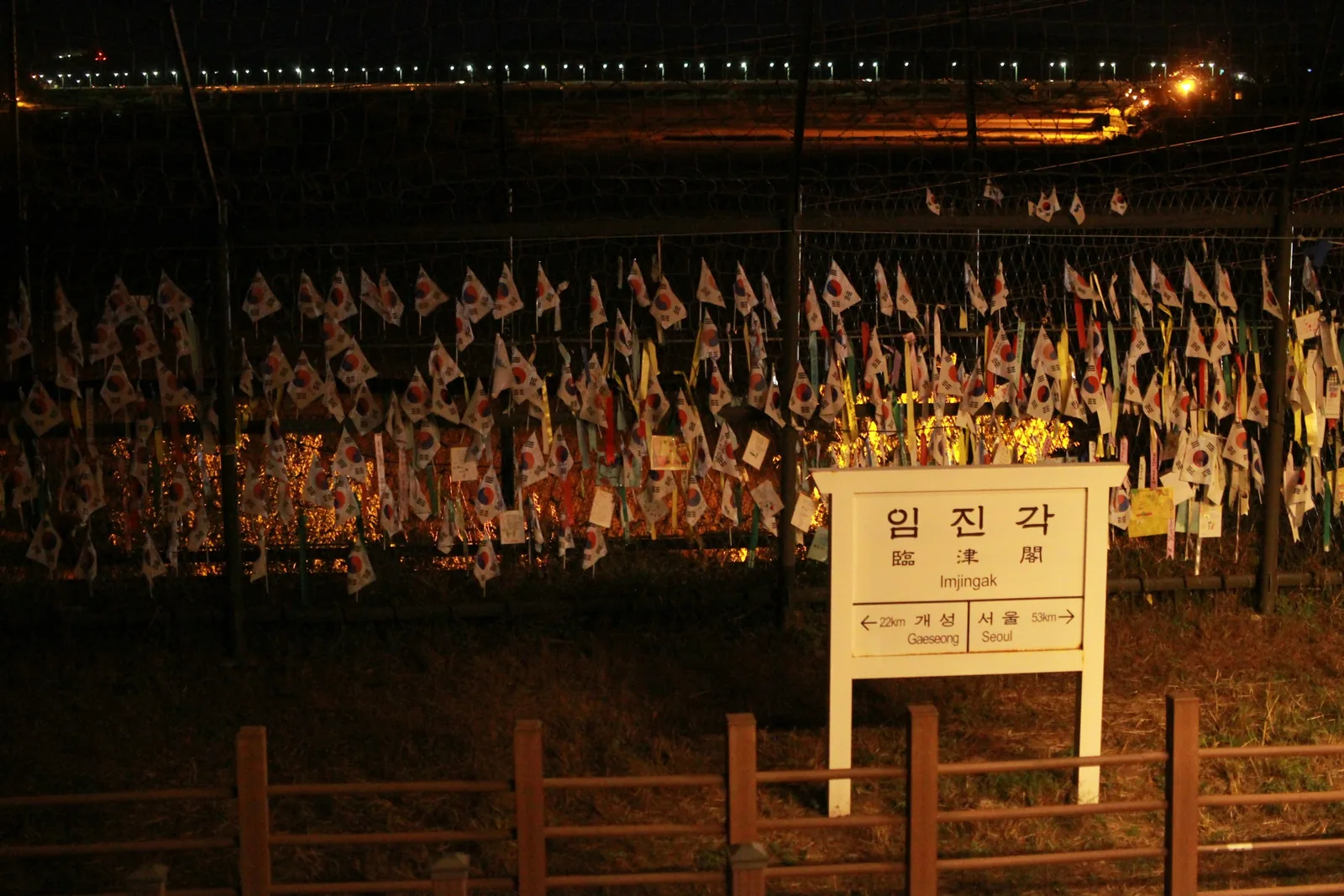
- Whole group present. Everyone must be at the ticket office; nobody can collect tickets for others.
- QR form and ID check. Register entry on your phone by QR code, show your ID, then get your ticket, even if you booked online.
- Cutoffs. Online bookers collect tickets 20 minutes before departure; walk-ups buy until 10 minutes before.
- Daily cap. Paju admits up to 3,000 people a day, and on-site sales can stop once that's reached.
Step 4: Prices, hours and closed days
Official prices, checked November 2, 2026. There's no discount for foreigners.
| Ticket | With monorail | Walking |
|---|---|---|
| Adult (19 and over) | ₩12,200 (about US$9) | ₩9,200 (about US$7) |
| Youth (13 to 18) | ₩9,500 | ₩7,000 |
| Seniors (65 and over) | ₩7,700 | ₩6,200 |
| Children 6 and under | Free | Free |
The monorail runs down the tunnel's steep slope at 9:20, 10:30, 11:30, 13:00 and 14:00; if it's out of service, you walk.
- Ticketing: 09:00 to 14:30.
- Weekday departures (Tuesday to Friday): 10 runs from 9:20 to 14:40. Weekends have 14 runs in the same window.
- Closed: every Monday, public holidays that fall on a weekday, and Seollal and Chuseok days themselves.
Paju's English timetable page differs slightly from the Korean one; the English booking screen matches the Korean page, so I used that.
What does an organized DMZ tour from Seoul include, and what does it cost?
Most organized tours follow the same route as the city shuttle, adding a bus from Seoul and an English-speaking guide. As of November 2, 2026, the typical setup:
- Pickup: a subway exit in Myeongdong, City Hall or Hongik University, between about 07:00 and 10:00.
- Route: Imjingak, the Third Tunnel and Dora Observatory, back in Seoul around 14:00 to 16:30.
- Add-ons: a North Korean defector talk, the Red Suspension Bridge or the gondola.
- Usually not included: lunch. Hotel pickup only on some tours.
- You need: your physical passport.
Price range: Klook's DMZ list showed US$45 to US$57.50 for regular group tours in October 2026, with a premium option at US$103.45. A VIP Travel tour on Viator ran US$50 to US$65 (October 2026). Three Klook tours on November 2, 2026:
- DMZ Tour; NK Defector Meet up & Suspension Bridge (activity 216): from ₩66,700 (about US$50), 5 hours, 4.9 stars from 48.2K reviews. Meets at Myeongdong, City Hall or Hongik University. The listing says nationals of JSA-restricted countries can join, and there's a Monday-only option with a North Korea view.
- DMZ Insider Tour (activity 77005): from ₩67,100 (about US$51), 7 to 9 hours, 5.0 stars from 12.5K reviews. Its policy: "DMZ is military area and can be closed suddenly without any notice. If it happens, alternative tour will be provided and no refunds." On Mondays it visits the Second Tunnel in Cheorwon instead of the Third Tunnel.
- DMZ Tour: Red Suspension Bridge & Observatory (activity 29601): from ₩60,400 (about US$46), 7 to 9 hours, "zero shopping stops," passport valid for 6 months.
All three offer free cancellation with 24 hours' notice; no-shows aren't refunded. Booking for November 23 to 30? None of these pages mentioned the Dora Observatory closure on November 2, so ask the operator what replaces it.
DMZ tour vs going solo: which should you choose?

| Group tour | On your own (Paju shuttle) | |
|---|---|---|
| Cost per adult | ₩60,400 to ₩67,100 on Klook (November 2, 2026) | ₩9,200 or ₩12,200, plus roughly ₩7,000 to ₩10,000 transport |
| Getting there | Bus from Seoul | Train to Munsan, then bus or train |
| Tickets | Operator holds seats | Few online seats, queue at 09:00 |
| Guide | English-speaking | None |
| Mondays | Some go to Cheorwon or a North Korea view spot | Closed |
| Sudden closure | 77005: alternative tour, no refund | Bookings can be cancelled; refund details not confirmed |
Go on your own if you're on a budget, don't need commentary, can book about a week ahead or reach Imjingak before 09:00, and your date isn't a Monday or weekday holiday.
Take a tour if your only free day is a Monday, you couldn't get an online seat and don't want to risk the queue, you want the history explained in English, or you'd rather skip two transfers. Read the closure policy first: with 77005, a sudden closure means a different tour, not your money back.
If a tour suits you better, this is the longer one with the Monday Cheorwon route:
DMZ rules: what applies to everyone, and what's JSA-only
A lot of advice for a DMZ tour in South Korea mixes old JSA rules with the regular course.
Rules for everyone on the Paju course (as of November 2026)
- Physical ID only. Passport, Alien Registration Card or US military ID. Copies, phone photos and expired passports are refused.
- No photos or video, drones included. Paju's Korean visitor guide says photos and video on the DMZ Peace Tourism course are completely banned, with CCTV in use. Since January 2, 2026, a group leader whose group films in a no-photo zone gets a warning, then entry bans of 10, 30 or 90 days. The English visitor guide omits this rule. Assume no photos inside the Civilian Control Line unless staff say otherwise.
- Stay on the route. Off-road areas are military zones with possible unmapped mines. No weapons, alcohol or fishing gear.
- Third Tunnel limits. Frail or elderly visitors, people with high or low blood pressure or respiratory illness, and anyone who has been drinking may be refused. The narrow, steep tunnel may also exclude wheelchair users.
- Kids: minors enter with an adult; children 6 and under are free.
JSA-only rules people still apply to the DMZ
- Nationality limits: Paju's official site lists none; those lists come from JSA tours. Some companies keep their own, though: one seller's "DMZ & JSA Tour" excludes nationals of Afghanistan, Cuba, Iran, Iraq, Libya, North Korea, Pakistan, Sudan and Syria. Klook's activity 216 says JSA-restricted nationals may join. Check before you pay.
- Dress code: bans on ripped jeans, sleeveless tops, shorts, slippers and military patterns are JSA rules. Paju lists no dress code. Wear walking shoes for the steep tunnel.
Other DMZ spots near Seoul
- Imjingak Peace Gondola: crosses the Imjin River toward Camp Greaves. As of November 2, 2026: daily 09:00 to 18:00, tickets until 30 minutes before closing. Adult round trip ₩12,000 (about US$9), crystal cabin ₩15,000 (about US$11.30). Camp Greaves is closed Mondays. Bring ID, since you enter the controlled zone. Some blogs and another tourism page list different hours and fares; I used the official site.
- Odusan Unification Observatory: in a different part of Paju from Imjingak, so pairing them by public transport isn't efficient. Per its site on November 2, 2026: November to February, 10:00 to 17:00 (last entry 16:30), closed Mondays. The fee is unclear: its visitor page says entry has been free since January 1, 2024, but its fee page still lists ₩3,000 for adults and ₩1,600 for students. Bring a little cash and your passport.
- DMZ Peace Link Train (DMZ 평화이음열차): since April 2026, a Korail Tourism Development tour train from Seoul Station to Dorasan Station, Dora Observatory and Camp Greaves, running on a Friday or Saturday each month. Base fare ₩47,600 (about US$36). I couldn't confirm whether foreigners can join. Paju's English page still shows the old Dorasan shuttle train, which ended in March 2026.
- DMZ Peace Trail: walking routes open April 17 to November 30, 2026, but the Ministry of Unification says only Korean nationals can take part.
What changed from 2024 to 2026, and when the DMZ closes without warning
- October 2024: after North Korea blew up inter-Korean roads, all Paju DMZ tours stopped on October 15 and resumed at 09:00 the next day.
- May 2025: JSA special tours restarted for officials only.
- August 2025: Dora Observatory's rooftop reopened.
- January 2, 2026: Paju began year-round enforcement, including the photo ban.
- March and April 2026: the Dorasan shuttle train ended; the Peace Link Train started.
- September 29, 2026: the Third Tunnel monorail resumed.
- November 23 to 30, 2026: Dora Observatory closed for road works.
Closures can come without warning. Paju says the schedule can be suspended for security threats, bad weather, rain or safety, and advance bookings can be cancelled. Snow also restricts entry in winter. Check the notices on dmz.paju.go.kr the night before, whichever way you visit the DMZ from Seoul.
FAQ
Is the JSA (Panmunjom) open to tourists in 2026?
Not for foreign visitors. As of November 2026, the Ministry of Unification says foreign tours are not operated, and its November calendar shows no tours. Only special tours for selected officials have run since May 16, 2025.
Can I visit the DMZ without a tour?
Yes. Paju City's shuttle leaves Imjingak for the Third Tunnel, Dora Observatory and Unification Village, about 3 hours. Bring your physical passport, and book on the English page or buy at the window between 09:00 and 14:30.
How much does a DMZ tour from Seoul cost?
The official shuttle is ₩9,200 walking or ₩12,200 with the monorail (adults, November 2026). Klook group tours started at ₩60,400 to ₩67,100 on November 2, 2026, about US$46 to US$51.
Do I need my passport? Will a photo of it work?
You need the physical passport. Paju refuses copies, phone photos and expired passports.
Is the DMZ open on Mondays?
The Paju course is closed every Monday, on weekday public holidays, and on Seollal and Chuseok days. Some tours switch on Mondays: Klook's activity 77005 goes to the Second Tunnel in Cheorwon.
Can I take photos at the Third Tunnel and Dora Observatory?
Plan on no. Paju's Korean visitor guide bans photos and video, drones included, with enforcement since January 2, 2026. The English page omits this rule.
Are there nationality restrictions or a dress code?
Paju's official site lists neither; both come from JSA rules. Some private tours keep their own nationality list, so check before paying.
What happens if the DMZ closes on my tour day?
Paju can suspend the course and cancel bookings for security or weather. With Klook's activity 77005, a sudden closure means an alternative tour and no refund.
Is Dora Observatory open in late November 2026?
No. It's closed November 23 to 30, 2026 for road works, possibly longer. The Third Tunnel stays open, with on-site tickets only.
Quick checklist
- Physical, valid passport
- Not a Monday, weekday public holiday, or Seollal or Chuseok day
- Not November 23 to 30, 2026 if you want Dora Observatory
- Book online about a week ahead, or reach Imjingak before 09:00
- Ticket window closes at 14:30
- No photos or video on the course
- Walking shoes
- Check Paju's notices the night before
Related guides
- Korea in Winter 2026-27: Seoul Weather, Festivals and What to Pack
- South Korea Travel Tips (2026): First-Trip Setup Checklist
- Apps You Need in Korea (2026): What to Install Before You Fly
Sources
- Paju City DMZ Peace Tourism: home and ticket status (Korean, checked November 2, 2026)
- Paju City DMZ Peace Tourism: visitor guide (Korean, checked November 2, 2026)
- Paju City DMZ Peace Tourism: visitor guide (English, checked November 2, 2026)
- Paju City DMZ Peace Tourism: prices (Korean)
- Paju City DMZ Peace Tourism: prices (English)
- Paju City DMZ Peace Tourism: timetable (Korean)
- Paju City DMZ Peace Tourism: online booking (English, checked November 2, 2026)
- Paju City DMZ Peace Tourism: FAQ (Korean)
- Paju City DMZ Peace Tourism: directions (Korean)
- Paju City DMZ Peace Tourism: Dora Observatory road closure notice (Korean, October 23, 2026)
- Paju City DMZ Peace Tourism: notices (Korean)
- Ministry of Unification: Panmunjom Tour Support Center (Korean, checked November 2, 2026)
- Ministry of Unification: Panmunjom visit application (Korean, checked November 2, 2026)
- Ministry of Unification: DMZ Peace Trail theme routes open (Korean, April 1, 2026)
- Korea.kr: DMZ Peace Trail 12 routes open from April 17 (Korean, April 1, 2026)
- Odusan Unification Observatory: visitor information (Korean, checked November 2, 2026)
- Odusan Unification Observatory: admission fees (Korean)
- Imjingak Peace Gondola: prices (Korean, checked November 2, 2026)
- Imjingak Peace Gondola: hours (Korean, checked November 2, 2026)
- Korail Tourism Development: DMZ Peace Link Train (Korean, checked November 2, 2026)
- VisitKorea: Regional DMZ Attractions (updated October 30, 2025)
- VisitKorea: Enjoy a Gondola Ride over the DMZ! (undated)
- Yonhap: Panmunjom tours partly resume after 18 months (Korean, May 15, 2025)
- Korea Herald: Panmunjom tourism to partially resume (May 15, 2025)
- Seoul Economic Daily: Panmunjom tours partly resume (Korean, May 15, 2025)
- Yonhap: Paju DMZ tours halted after road demolition (Korean, October 15, 2024)
- Yonhap: DMZ tours resume after one day (Korean, October 16, 2024)
- Munhwa Ilbo: Paju DMZ Peace Tourism and Dora Observatory rooftop (Korean, September 2, 2025)
- Aju Business Daily: DMZ access limits and 2025 Panmunjom special tours (Korean, October 28, 2026)