Busan for First-Timers 2026: Airport, Getting Around, Where to Stay
Last checked: November 8, 2026 · How I check facts
This post contains affiliate links. If you book through them, we may earn a small commission at no extra cost to you.
Quick answer: On a first trip, stay in Seomyeon for the easiest connections or in Haeundae for the beach. From Gimhae Airport, Airport Limousine 2 runs to Seomyeon for ₩6,000 and Limousine 1 runs to Haeundae for ₩9,500, card only, as of November 2026. From Seoul, a standard KTX seat costs ₩54,400.
I checked fares on November 8, 2026, on the official pages of Busan City, Busan Transportation Corporation, Korea Airports Corporation and Korail. I live in Seoul and haven't documented a Busan trip for this guide, so it rests on those sources. Travel times from third-party sites are marked as estimates.
You won't need a car. You also can't use a Seoul Climate Card here.
In this guide: jump to a section
- How do you get into the city from Gimhae Airport?
- How do you get to Busan from Seoul?
- Busan Station to Haeundae, Seomyeon and Nampo
- How much is the Busan metro, and which card works?
- Visit Busan Pass, K-Tour Pass and the city tour bus
- Do you need a rental car in Busan?
- Where to stay in Busan by transit access
- Day trip to Gyeongju
- Getting to Incheon Airport
- Busan in November and December 2026
- FAQ
- Quick checklist
How do you get into the city from Gimhae Airport?

Gimhae International Airport (PUS) sits on the west side of Busan. You have four ways in.
Airport Limousine 1 and 2
Both routes were reorganized on January 5, 2026. Both take cards only. As of November 2026:
| Route | Fare | From the airport | Ride time |
|---|---|---|---|
| Limousine 2 | ₩6,000 | 07:20 to 21:30, every 60 to 80 min | 50 min |
| Limousine 1, Jangsan route | ₩9,500 | 07:10 to 16:50 | 90 min |
| Limousine 1, Gijang route | ₩9,500 | 10:10 to 21:40 | 110 min |
Limousine 2 stops at Jurye Station, Dongeui University Station, Seomyeon Station (Lotte Hotel), Bujeon Market and Bujeon Station. Limousine 1 stops at BEXCO and Shinsegae Centum City, the Yachting Center, Haeundae Beach and Jangsan Station, and the Gijang route continues to Osiria and Gijang. Limousine 1 departures are spaced unevenly.
Board at Platform 3 on the first floor of either terminal. Book a QR ticket in the Bustago app, or use the ticket machine at the airport bus ticket office on the first floor. No free transfer to the metro applies.
Limousine 2 dropped from ₩7,500 to ₩6,000 in January, so older pages still show the higher fare. And on the Jangsan route, the last bus leaves at 16:50.
Neither limousine goes to Nampo or Busan Station.
Light rail plus metro
The Busan-Gimhae Light Rail (BGL) stops at the airport and runs 05:00 to midnight. Change at Sasang for Line 2 (Seomyeon, Gwangalli, Haeundae) or at Daejeo for Line 3. A third-party check puts the whole trip at about ₩1,600 to ₩1,800 with a transit card. Transfers are free or discounted with a card; Busan City says the extra charge ended in September 2025, but the BGL fare page still lists ₩500.
Nampo or Busan Station means a second change at Seomyeon onto Line 1.
Taxi (estimates)
The airport's own estimates: Seomyeon about ₩18,000 and 45 minutes, Nampo about ₩20,000 and 60 minutes, Haeundae or Gwangalli about ₩25,000 and 70 minutes. The meter decides, and late-night fares run higher.
Third-party guides say city bus 3003 heads toward Nampo and Jagalchi. I found no official timetable, so check it in a map app first.
How do you get to Busan from Seoul?
Take the KTX. Since September 1, 2026, KTX and SRT run as one network, SRT trains are now called KTX-Sancheon, and fares fell about 10% on average.
As of November 2026, Seoul Station to Busan costs ₩54,400 in standard and ₩78,900 in first class. Suseo to Busan is ₩52,900. The new Korail+ app searches both stations at once. Many pages still quote ₩59,800, the old fare.
Expect about 2 hours 15 minutes on the fastest trains and up to about 3 hours on slower ones (estimate). Busan Station connects to Metro Line 1. For paying with a foreign card, see my KTX booking guide for foreigners.
Express buses are cheaper and slower. Third-party sites that checked Kobus after the 9% fare cap rise on October 1, 2026, list about ₩29,100 to ₩56,200 and about 4 hours. They arrive at Busan Central Bus Terminal in Nopo, the northern end of Line 1 and a long ride from Haeundae or Nampo.
Busan Station to Haeundae, Seomyeon and Nampo
Take Line 1 toward Nopo, change at Seomyeon, then ride Line 2 toward Jangsan to Haeundae. A few guides say Line 1 goes there directly. It doesn't.
That trip is ₩1,800 by card because it's over 10 km, and takes about 45 to 50 minutes (estimate). Seomyeon is about 11 minutes up Line 1 and Nampo about 4 minutes the other way (estimates), both ₩1,600.
How much is the Busan metro, and which card works?
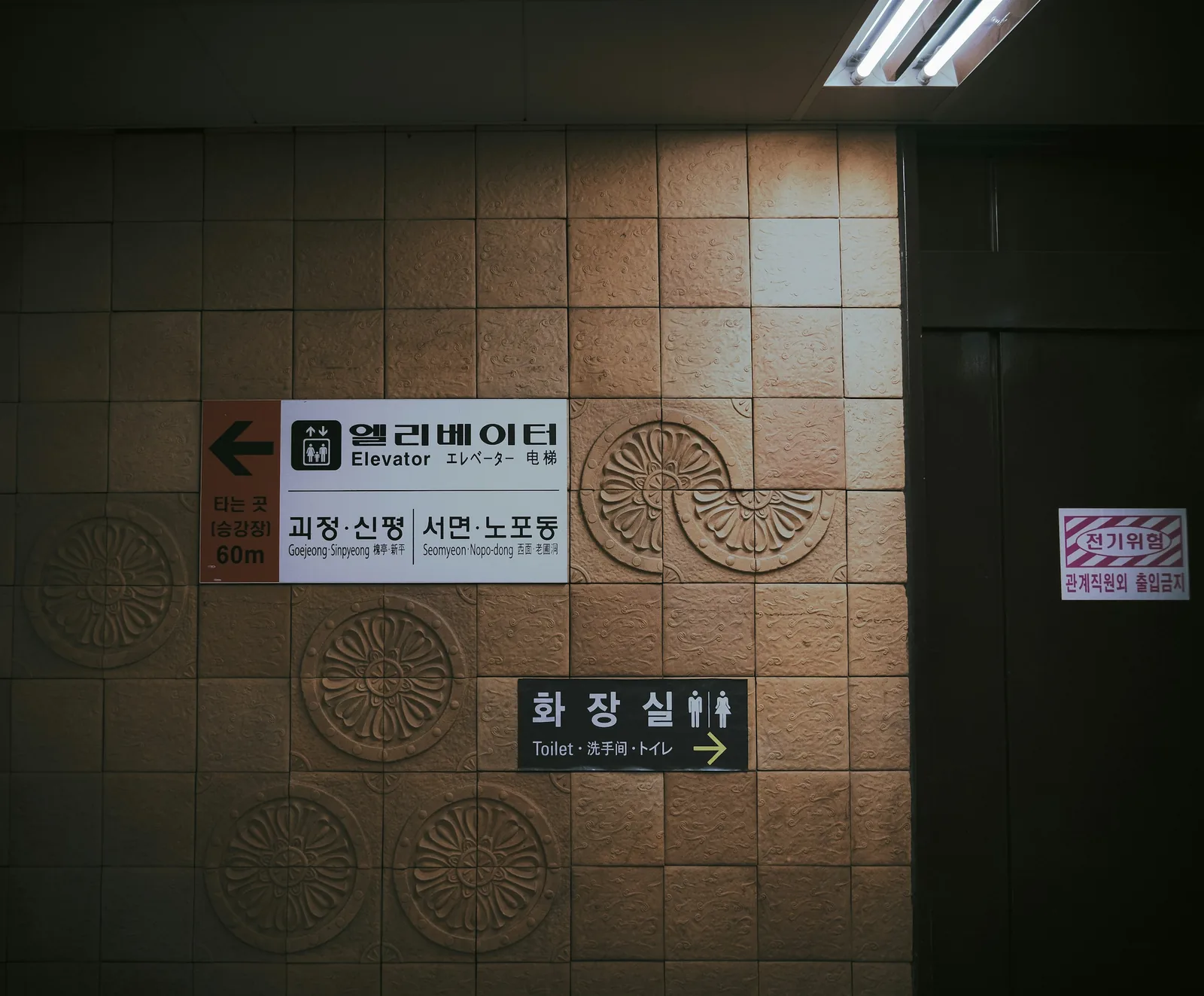
Busan has four metro lines, plus the BGL and Korail's Donghae Line. Visitors mostly need Lines 1 and 2.
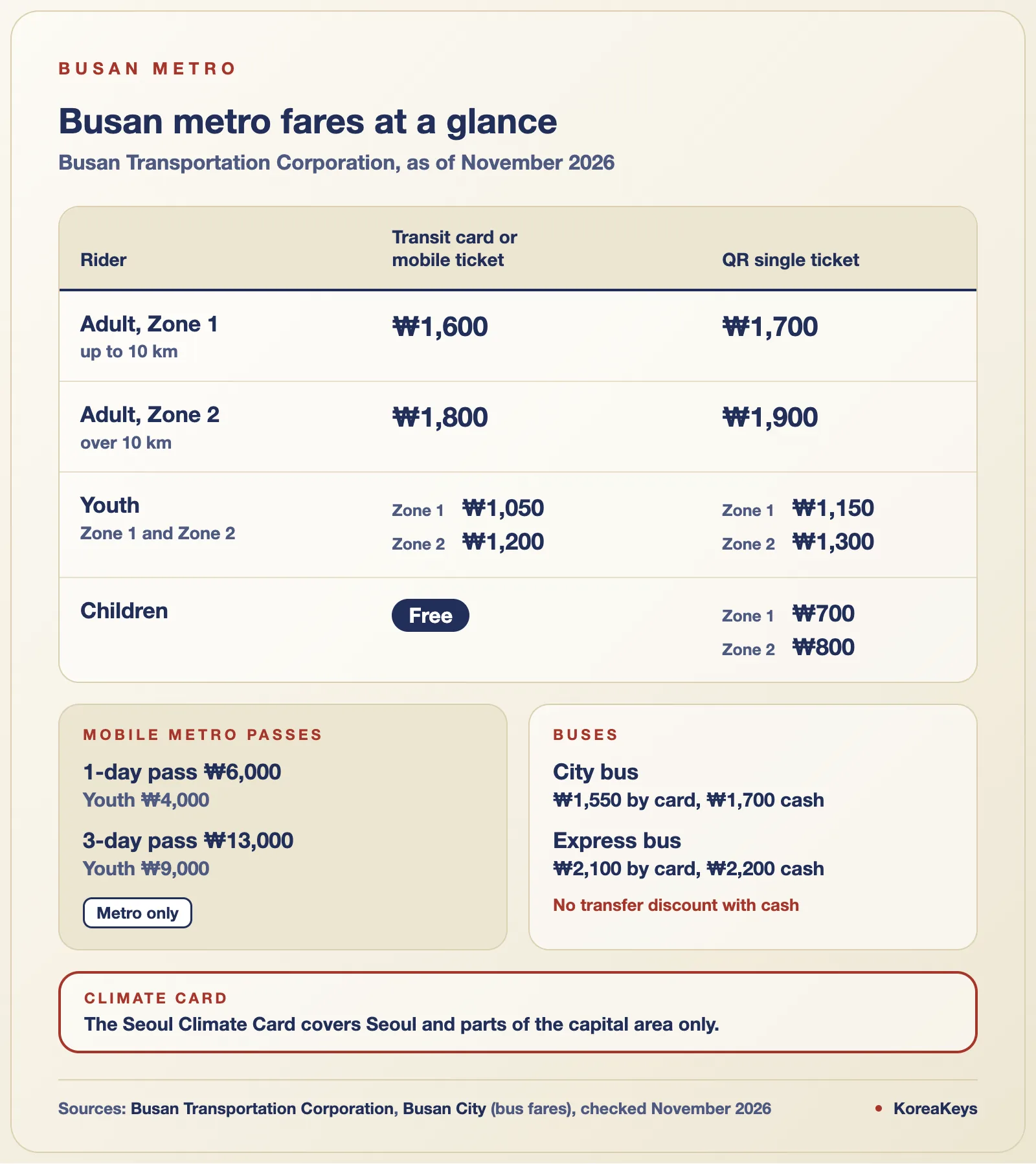
Busan Transportation Corporation fares, as of November 2026:
| Rider | Transit card or mobile ticket | QR single ticket |
|---|---|---|
| Adult, Zone 1 (up to 10 km from your start station) | ₩1,600 | ₩1,700 |
| Adult, Zone 2 (over 10 km) | ₩1,800 | ₩1,900 |
| Youth, Zone 1 / Zone 2 | ₩1,050 / ₩1,200 | ₩1,150 / ₩1,300 |
| Child | Free | ₩700 / ₩800 |
The operator's app sells a 1-day pass for ₩6,000 and a 3-day pass for ₩13,000. A third-party guide says the day pass covers the metro only, so it pays off at four or more rides. Older guides still list a ₩1,300 base fare, which is out of date.
A T-money or Cashbee card works on the metro and buses, including one bought in Seoul. I couldn't confirm that foreign contactless bank cards open the gates, so plan on a transit card or a QR ticket.
City buses cost ₩1,550 by card or ₩1,700 in cash, and cash loses the transfer discount. I haven't verified bus routes for this guide, so get the numbers from Naver Map in English. The Donghae Line takes the same card, with fares that rise with distance; sources disagree on the exact amounts.
Can you use the Climate Card in Busan?
No. The Seoul Climate Card covers Seoul and parts of the capital area only.
Visit Busan Pass, K-Tour Pass and the city tour bus
Visit Busan Pass
This attractions pass is for non-Koreans only. The 24-hour mobile pass costs ₩55,000 and covers each listed attraction once, starting from your first entry. Screenshots and printouts of the QR code are refused. The card version can also be loaded as a transit card; the mobile one can't. Pick it up at the pass counter in Busan Station or at the tourist information center in Gimhae's international terminal.
Buy it only if you plan several paid attractions in a day. It isn't a transit pass.
K-Tour Pass (pilot since October 1, 2026)
The Ministry of Culture, Sports and Tourism launched a Busan pilot on October 1, 2026, in two versions at ₩15,000 each: Pass 1, a one-day pass for a trip to Busan, and Pass 2, linked to a 2- to 5-day Korail Pass.
The government says you get one free entry among 35 paid attractions, discounts at 50 partner places, and 40% off one-way intercity transport to Busan. You buy it on Klook or Webtour (Hop&Hop). The card itself is free at kiosks in Incheon, Gimpo and Gimhae airports and at Seoul and Busan stations.
VisitKorea's own page caps the transport discount at ₩24,000. The end date comes from news reports, which say the coupons and mobile tickets run until December 31, 2026. One outlet worked out that 40% of the ₩54,400 KTX fare is about ₩21,700, more than the pass price. I haven't checked the Klook listing's train rules, so read them before you buy.
Busan City Tour bus
The official hop-on bus has three loops. The Red Line links Busan Station and Haeundae, the Blue Line runs out to Yonggungsa and Gijang Market, and the Green Line goes to Taejongdae. A ₩15,000 single ticket covers one line (₩5,000 more to switch). A ₩20,000 24-hour ticket covers all three. Pay the crew on board, cash or card.
It doesn't run on Mondays, unless the Monday is a public holiday.
Do you need a rental car in Busan?
Mostly no. Every area in this guide is on the metro, the light rail or an airport limousine.
To drive, you need an International Driving Permit (IDP) issued under the Geneva or Vienna convention, valid for one year from your entry date, per the Korea Road Traffic Authority. Look-alike "International Driving License" documents, such as those from the US IAA, are not valid. I didn't check rental desks, insurance or tolls for this guide.
Where to stay in Busan by transit access
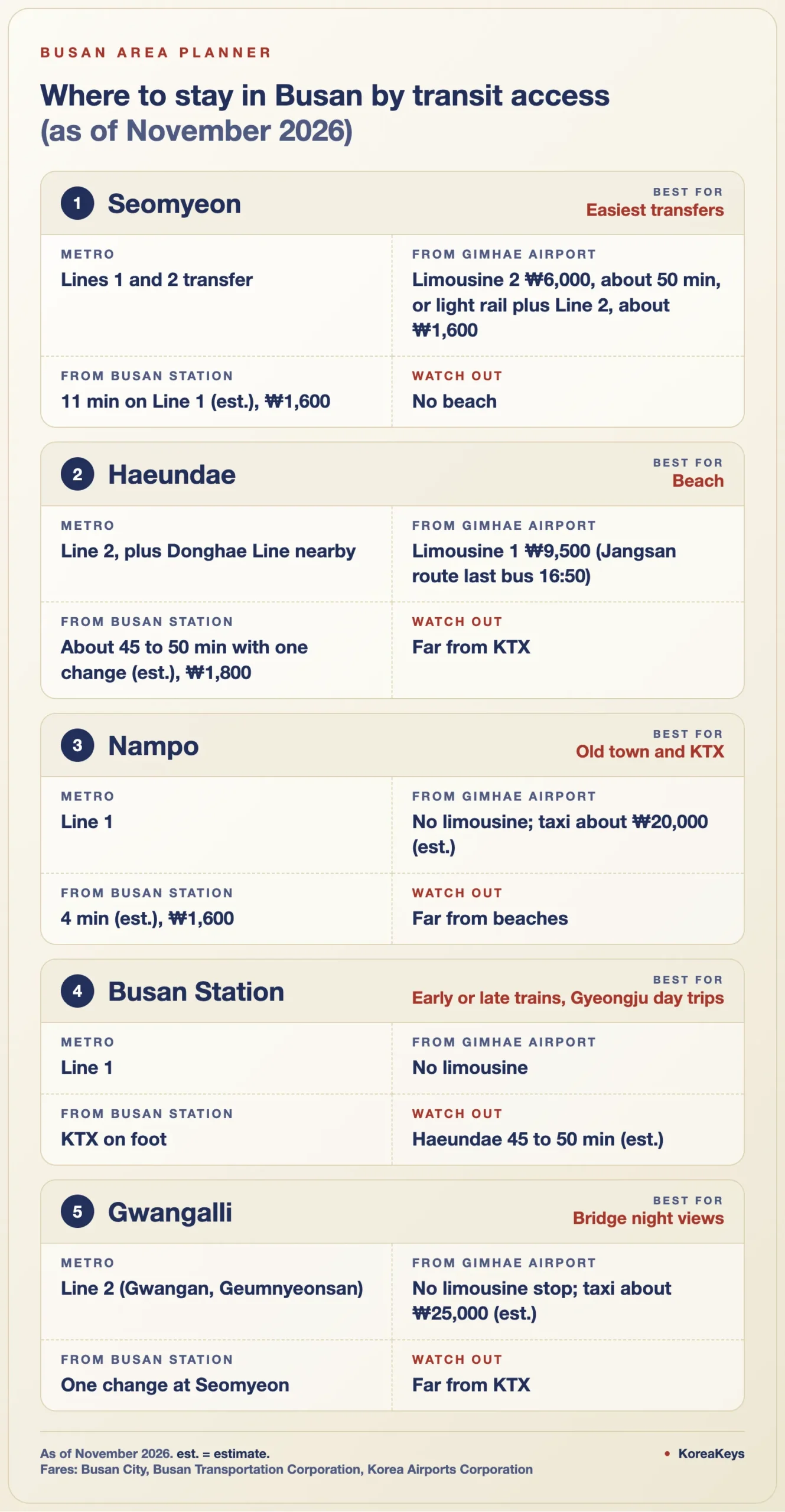
The graphic and table use the official routes and fares above; "est." marks third-party estimates.
| Area | Best for | Watch out |
|---|---|---|
| Seomyeon | Easiest transfers (Lines 1 and 2), ₩6,000 airport bus | No beach |
| Haeundae | The beach, direct airport bus (₩9,500) | Far from KTX and Nampo |
| Nampo | Old town, 4 min from Busan Station (est.) | No airport bus, far from beaches |
| Busan Station | Early or late KTX, Gyeongju day trips | 45 to 50 min to Haeundae (est.) |
| Gwangalli | Bridge views, between Seomyeon and Haeundae | No airport bus, far from KTX |
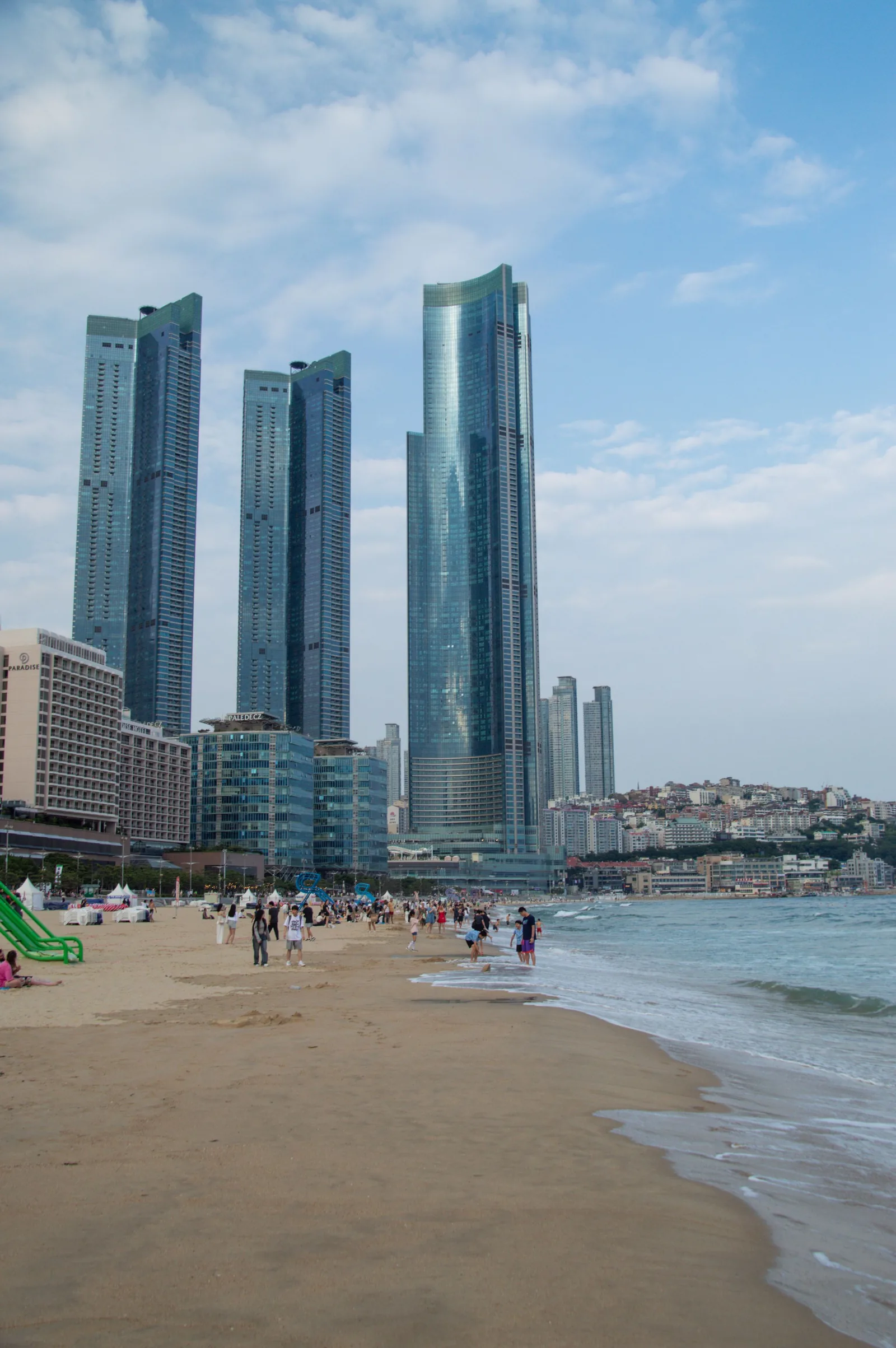
My reading: flying in for a short trip, Seomyeon is the safe pick. If the beach is the point, Haeundae has the only direct airport bus, though the Jangsan route stops early. Arriving by KTX and planning Gyeongju? Busan Station or Nampo saves time.
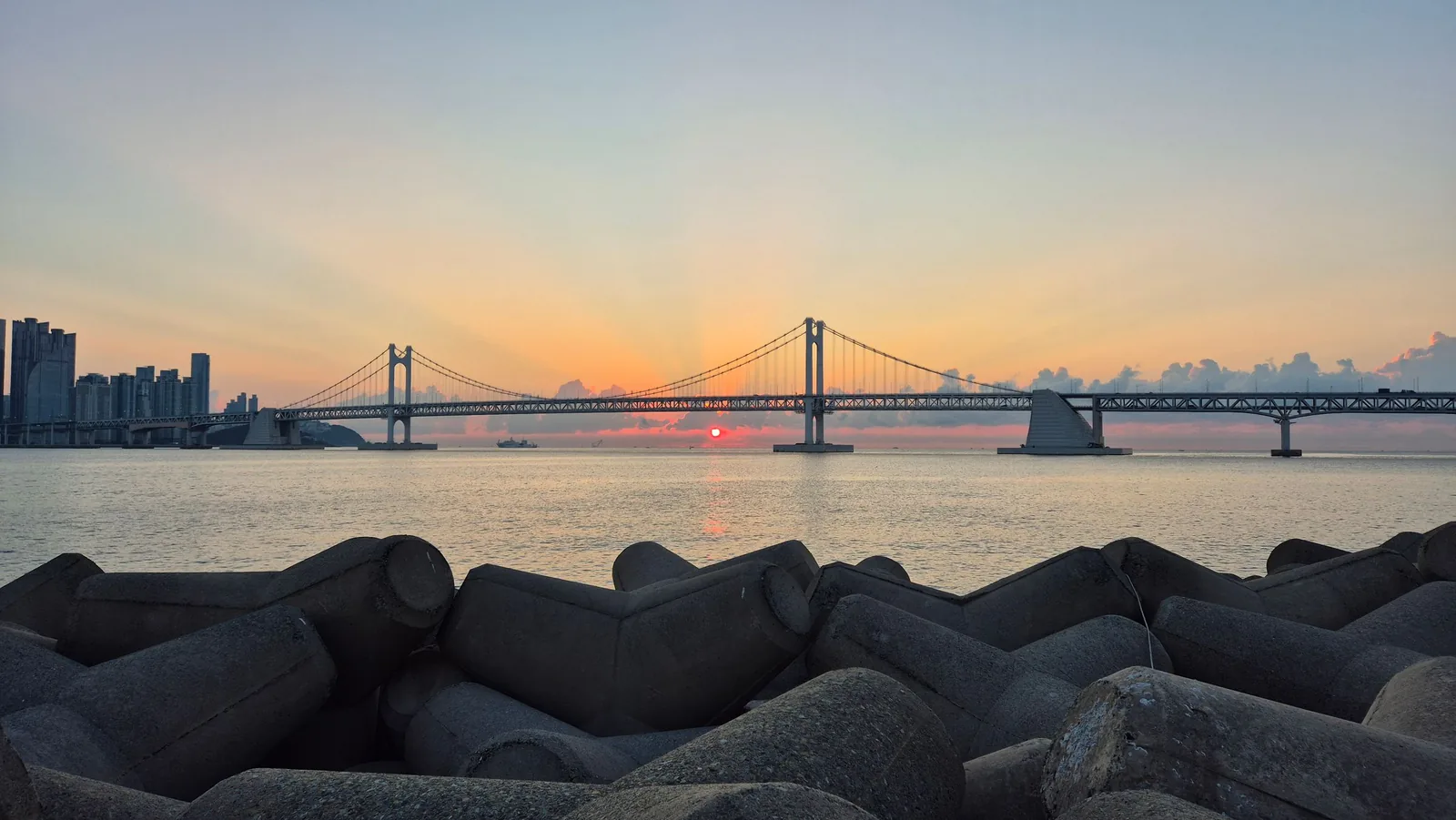
Gwangalli sits in the middle. Its stations are a short walk back from the water; I couldn't confirm how long.
Day trip to Gyeongju
The KTX to Gyeongju Station (formerly Singyeongju) leaves Busan Station and takes about 27 to 36 minutes. Third-party timetables built on Korail data show about ₩10,000 to ₩11,000 one way, so check the exact fare in Korail+.
Staying in Haeundae? Use Sinhaeundae Station on the Donghae Line. Third-party listings show the KTX-Eum at about ₩10,900 and the ITX-Maeum at about ₩8,700 from there.
Getting to Incheon Airport
There's no direct train. The simplest rail route is the KTX to Seoul Station (₩54,400), then the AREX Express (₩13,000, about 43 minutes to Terminal 1 and 51 minutes to Terminal 2).
The Busan connecting flight to Incheon is only for passengers continuing on Korean Air or a codeshare partner, Yonhap reported. Busan Central Bus Terminal also lists Incheon Airport as a destination, and a third-party listing shows about 5 hours from Haeundae. I couldn't confirm the fare after the October increase, so check before you go.
Busan in November and December 2026
Haeundae-gu's official events calendar lists the Haeundae Lighting Festival for November 29, 2026, to January 18, 2027, around Gunam-ro and Haeundae Beach. Other sites list different dates, and that calendar was last updated in May, so check the district's notice.
Event listings also show the Seomyeon light festival until February 14, 2027, and Christmas Village Busan at the Busan Cinema Center between November 26 and December 25. G-STAR, the game show, fills BEXCO in Haeundae November 19 to 22, and I'd expect nearby hotels to be busier (my estimate).
FAQ
What is the best area to stay in Busan for first-timers?
Seomyeon for transit, Haeundae for the beach. Seomyeon is the Line 1 and 2 transfer station with a ₩6,000 airport limousine. Haeundae has the ₩9,500 direct limousine.
How do I get to Haeundae from Gimhae Airport?
Airport Limousine 1 (₩9,500, card only) from Platform 3, first floor. Last buses: 16:50 on the Jangsan route, 21:40 on the Gijang route. The light rail plus Line 2 costs less but needs a change at Sasang.
Does Line 1 run directly to Haeundae?
No. Change at Seomyeon to Line 2. It's ₩1,800 by card and about 45 to 50 minutes (estimate).
How much is a Seoul to Busan KTX ticket?
₩54,400 in standard from Seoul Station, as of November 2026.
Is the K-Tour Pass worth it?
Probably, if you take the KTX down from Seoul. A 40% discount on ₩54,400 is about ₩21,700, more than the ₩15,000 price. Read the Klook train rules first.
Quick checklist
- A credit card for the airport limousine (no cash)
- A T-money or Cashbee card, topped up
- The 16:50 last bus on the Jangsan route
- KTX booked in Korail+ for ₩54,400
- K-Tour Pass rules read, coupons valid to December 31, 2026 (per news reports)
- No city tour bus on Mondays
- A Geneva or Vienna IDP, only if you'll drive
- Haeundae Lighting Festival dates checked with Haeundae-gu
Related guides
- How to Book KTX Tickets as a Foreigner (2026): Booking, Fares and the KTX Pass
- Incheon Airport to Seoul (2026): AREX vs Airport Bus vs Taxi
- Kakao T, k.ride or Uber? Best Korea Taxi App for Foreigners (2026)
Sources
- Busan City: Gimhae Airport limousine reorganization (Korean, effective January 5, 2026)
- Busan Metropolitan City: Busan Airport Limousine Buses Reorganized (January 13, 2026)
- Korea Airports Corporation: Gimhae Airport public transportation (English)
- Korea Airports Corporation: Gimhae Airport taxi fare estimates (Korean)
- Busan Metropolitan City: Public Transportation (bus fares, metro, Donghae Line, terminals)
- Busan Transportation Corporation: metro fares (Korean, checked November 8, 2026)
- Busan Transportation Corporation: metro fares (English)
- Busan Transportation Corporation: BGL light rail information
- BGL: fares (English)
- Busan City: free transfers between Busan, Gimhae and Yangsan (Korean, October 2, 2025)
- Seoul Metropolitan Government: how to use the Climate Card (Korean)
- Korail: integrated high-speed rail operation from September (Korean, August 5, 2026)
- Hankyung: Seoul to Busan KTX at ₩54,400 from September 1 (Korean, August 31, 2026)
- Aju Press: KTX Fares Drop by 5,400 Won, While Express Bus Fares Increase by 9% (October 1, 2026)
- Visit Busan Pass: official pass page
- Visit Busan Pass: official guidebook (Japanese, PDF)
- Korea.kr policy briefing: K-Tour Pass launches with a Busan pilot (Korean, October 1, 2026)
- VisitKorea: K-Tour Pass, transportation discounts and free admission in Busan (English)
- Korea.net: K-Tour Pass (Korean, October 1, 2026)
- Asia Today: K-Tour Pass discount cap and coupon period (Korean, October 1, 2026)
- Aju Business Daily: K-Tour Pass savings on the KTX (Korean, October 1, 2026)
- Busan City Tour: courses and fares (Korean)
- Korea Road Traffic Authority: international driving permits (Korean)
- Yonhap: more Busan to Incheon connecting flights (Korean, April 3, 2026)
- Haeundae-gu: 2026 events calendar (Korean, updated May 8, 2026)
- Third-party: Korea Transit, Gimhae Airport guide (September 2026)
- Third-party: Day One Korea, Busan Station to Haeundae (October 2026)
- Third-party: Korea Charts, Busan to Gyeongju train times (Korean, November 2026)
- Third-party: Epickor, Busan to Gyeongju (October 2026)
- Third-party: Korea Travel Atlas, express buses (October 2026)
- Third-party: busan.net, November 2026 events