Korea Smart Entry Service for Tourists: 42 Countries Can Use the Autogate (2026)
Last checked: October 9, 2026 · How I check facts
Travelers aged 17 and over from 42 countries and regions can use Korea's automated immigration gates (autogates) when they enter visa-free. You don't register abroad. You register in person at a registration desk in the arrival hall at Incheon Airport (or Jeju Airport), scanning your passport, fingerprints and face. It's a one-time step, and I found no fee on the official pages.
The big payoff comes on your next trip, when you can skip the foreigner line. The US is not on the list. As of October 2026, the Ministry of Justice (MOJ) reports 1,419,960 registrants from November 3, 2025 to August 31, 2026.
The short version (as of October 2026):
- Who: citizens of 42 countries and regions, age 17 or older, entering without a visa.
- Where to register: arrival hall registration desks at Incheon (Terminal 1 and Terminal 2) and Jeju.
- How: passport scan, fingerprints, face photo. You get a sticker in your passport, according to traveler reports.
- First visit: the official steps say register, then use the autogate. Travelers report that the desk can act as your immigration check instead.
- Still required: e-Arrival card, unless you hold a K-ETA (a travel authorization some travelers need).

In this guide: jump to a section
Who Can Use the Smart Entry Service?
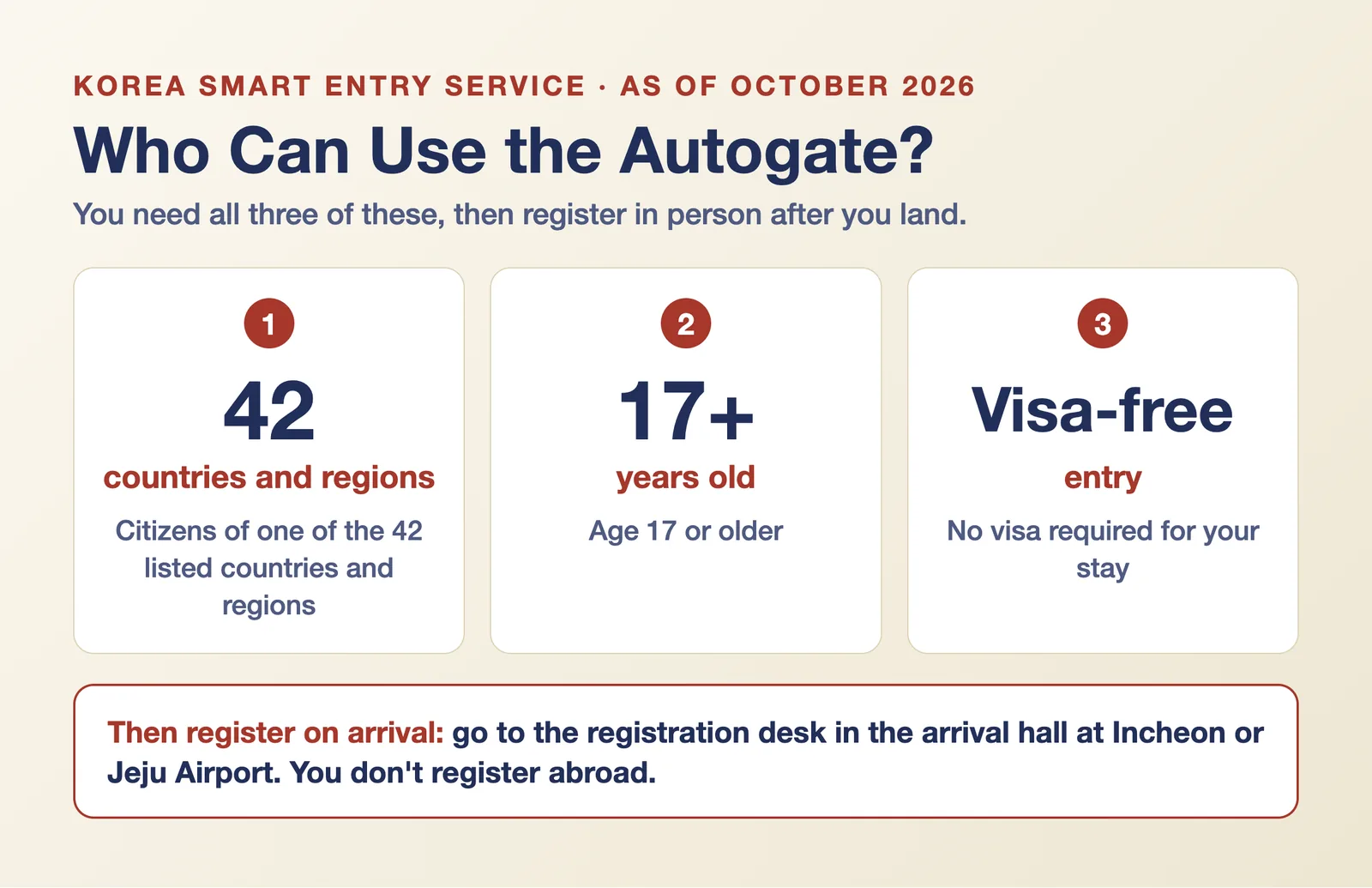
You need all three of these. They come from the MOJ's October 1, 2026 press release.
- Nationality: one of the 42 countries and regions below.
- Age: 17 or older.
- Entry type: visa-free (no visa required for your stay).
The list grew in three steps. Four places started on November 3, 2025 (Germany, Taiwan, Hong Kong, Macao). Fourteen more joined on December 1, 2025. The last 24 joined on March 16, 2026, which is why you may see that date called the launch. It was the final expansion.
All 42 countries and regions
| Added | Countries and regions |
|---|---|
| Nov 3, 2025 (4) | Germany, Taiwan, Hong Kong, Macao |
| Dec 1, 2025 (14) | Japan, Singapore, United Arab Emirates, Mexico, Czech Republic, United Kingdom, Finland, France, Hungary, Italy, Netherlands, Portugal, Australia, New Zealand |
| Mar 16, 2026 (24) | Canada; Norway, Liechtenstein, Switzerland, Iceland; and 19 EU members: Greece, Denmark, Latvia, Romania, Luxembourg, Lithuania, Malta, Belgium, Bulgaria, Sweden, Spain, Slovakia, Slovenia, Ireland, Estonia, Austria, Croatia, Cyprus, Poland |
China, India and Thailand are not on the list. Neither is the United States.
Who can't register: the official eligibility pages list these cases.
- Your fingerprint or face quality is too poor for the machine to confirm your identity.
- You're under an entry ban under Korean immigration law.
- You were ordered deported or paid a penalty over ₩5 million within the last 3 years (from the MOJ English page).
- The Minister of Justice otherwise deems you ineligible.
Your passport also needs to be machine-readable. A single-entry passport is excluded under the MOJ rule I found, though that rule's current status isn't confirmed. One travel blog says you need an e-passport, but I found no official source for that.
What about the US? American citizens are not among the 42. The US route is a separate program for Global Entry members, applied for through HiKorea. Its status changed several times in 2026, so check HiKorea before relying on it. I couldn't confirm the current fee or whether it's working normally.
An old English page: the MOJ's English Smart Entry Service page still lists only the USA, Hong Kong and Macao. The full 42-country list comes from the MOJ's March 16, 2026 press release. If you see conflicting lists, trust the press release.
How to Register, Step by Step
Registration is in person, after you land. The official sequence is: passport scan, fingerprints, face, registration complete, then autogate.
- Land and follow the signs. Look for the Smart Entry Service registration signs in the arrival hall. Travelers describe a separate line from the regular immigration queue.
- Find a desk. At Incheon, the MOJ says there are registration desks on the east and west sides of the Terminal 1 arrival hall and on the east and west sides of the Terminal 2 arrival hall. That's four desks. Jeju Airport also has a desk.
- Show your passport and scan both index fingers, as the MOJ rule specifies.
- Look at the camera for one face photo.
- Get your sticker. Travelers report a sticker on the back of the passport. Staff can use it to point you to the autogate line next time.
The desk is staffed, not a self-service kiosk. A traveler who registered in April 2026 said the process took about five minutes. Another traveler waited 20 minutes in the regular line first. Queues vary a lot.
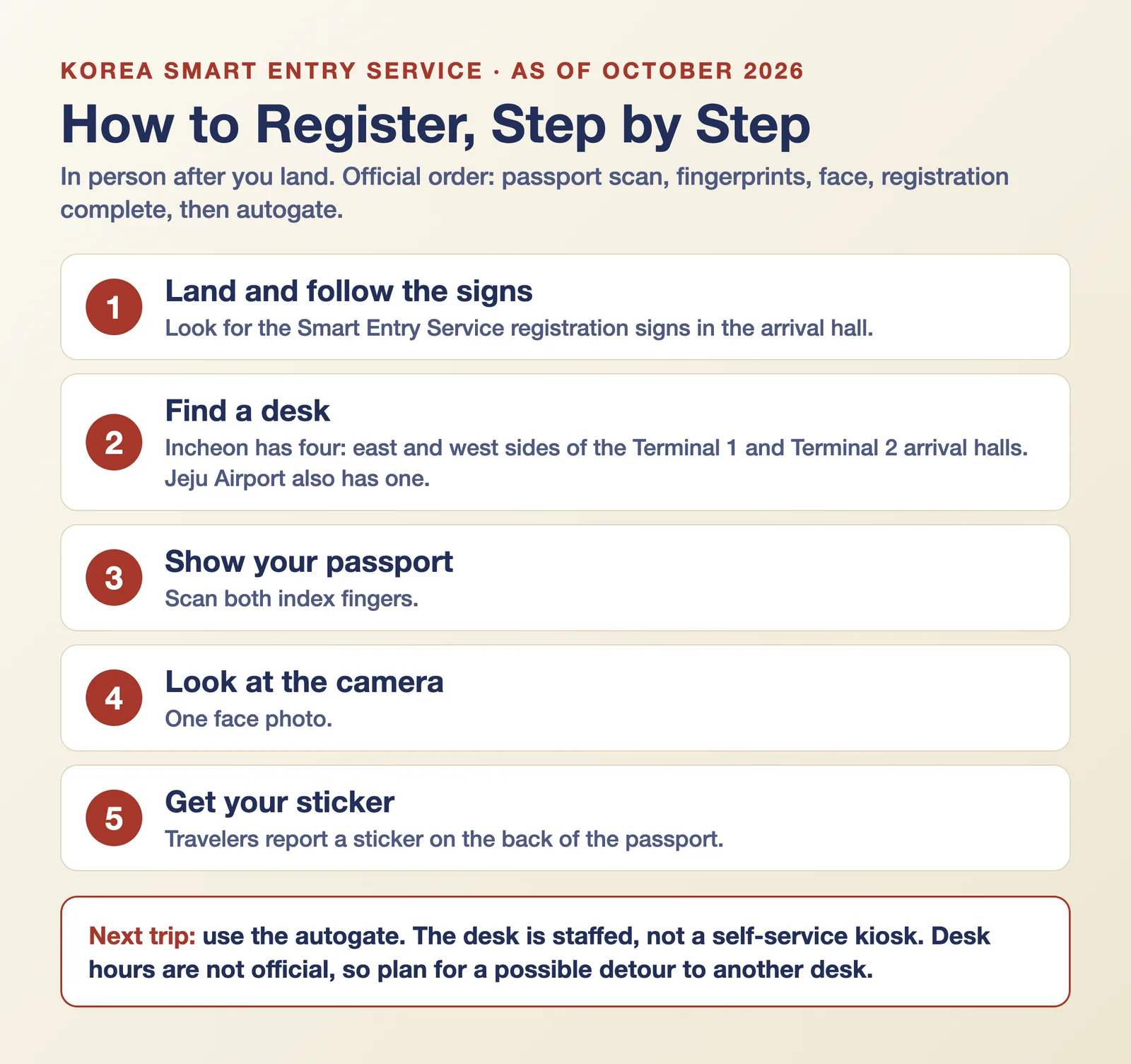
Desk hours are not official. I found no official hours for the arrival hall desks. Travel blogs list different hours per desk, and travelers report desks closing earlier than posted or opening late. Plan for a possible detour to another desk.
Where it doesn't work (yet): registration at Gimpo, Gimhae and other regional airports is not officially confirmed. One Australian traveler reported being turned away at Gimpo. Once you're registered, though, you can use autogates at other airports. The MOJ reports a 66.6% reuse rate at regional airports like Gimpo and Gimhae. Jeju registration began as a trial from March 9 to June 30, 2026. The MOJ now lists Jeju as an operating site, but I found no notice about the trial's extension.
Don't go to the departure-area office. The Incheon Airport English page says registration there is for departing passengers only, and it appears to predate arrival hall registration. A traveler reported being turned away there in March 2026.
Don't confuse it with Smart Pass. Incheon's Smart Pass (face recognition at security and boarding) is a separate service from the MOJ's Smart Entry Service.
What Happens at the Autogate
Once registered, the gate is quick. HiKorea lists the steps, and they may vary by machine:
- Place your passport photo page down on the scanner.
- Look at the camera for face recognition (some gates skip this step).
- Walk in when the entry door opens.
- Put your registered finger on the fingerprint scanner. The screen shows which finger is registered.
- Exit when the second door opens.
One blog says the gate itself takes 15 to 30 seconds. If you want an entry stamp, ask an officer. The MOJ rule says you can request one after using the autogate, though that rule is from 2023.
Leaving Korea: visitors aged 17 and over who gave fingerprints and a face scan on entry can use the departure autogate without registering.
First visit: what to expect
Sources conflict here. Officially, you register and then use the autogate. The MOJ's press release and some reports describe it that way, and one blogger walked about 5 meters from the desk to the gate. Other travelers report the desk itself acts as your immigration check, so you don't get a separate autogate pass that day.
Either way, the clear benefit starts on your next trip. One Reddit traveler put it as "register on your next trip." I'd plan around that. Don't count on saving time on your first arrival.
Common Problems and What to Do
- Long first-arrival queues. Some travelers waited up to 2 hours at immigration, while others report 5 minutes. A Korea Herald opinion column, written by a government official, argues registration adds a second wait for some passengers. This is opinion, not a MOJ statement.
- A desk says it's closed or can't register you. Ask where the other desks are. One traveler was told the desk had closed, then sent to another counter and registered.
- You arrive at Gimpo or Gimhae. Registration isn't officially confirmed there. Register at Incheon or Jeju on a later trip.
- Your fingerprints don't read well. Poor quality is an official reason for ineligibility. The MOJ rule says damaged index fingers can be swapped for other fingers.
- An American citizen asks if they count. They aren't in the 42. See the US note above.
- Official pages disagree. HiKorea and the MOJ's English and Korean pages are not all current. Use the March 16 and October 1 press releases for the list.
Do You Still Need e-Arrival or K-ETA?

These are three separate things.
e-Arrival card: the official rule exempts registered foreign residents, holders of a valid K-ETA, and airline crew. I found no official exemption for Smart Entry Service registrants. Some forum posts say there is one, but I couldn't verify that. Unless you hold a K-ETA, submit the card. Incheon Airport says you can submit it from 72 hours before arrival. My Korea e-Arrival card guide walks through it.
K-ETA: the temporary K-ETA exemption runs through December 31, 2026, according to the K-ETA notice. Travelers from exempt nationalities can enter without a K-ETA. Whether your passport is exempt appears in a pop-up on the K-ETA site when you pick your nationality. After 2026, I couldn't find the policy, so check before booking. K-ETA holders also skip the arrival card, and the K-ETA notice says an application fee applies if you apply voluntarily.
Smart Entry Service: it speeds up your immigration check on later visits. It doesn't replace either of the above. Being on the 42-country list doesn't tell you whether you need a K-ETA, so check the K-ETA site for your passport.
Once you're through, my Incheon Airport to Seoul guide covers trains, buses and taxis. If you want data before you land, see the Korea eSIM guide. If a taxi is your plan, the taxi apps guide explains k.ride and Kakao T.
👉 See the official autogate steps on HiKorea
FAQ
Is the Korea Smart Entry Service free?
I found no fee on the official pages. A traveler who registered in April 2026 reported no charge. The US Global Entry route is a separate case that reportedly has its own fee, which I couldn't confirm.
Can I register before I fly to Korea?
No. Registration is in person at the airport after you arrive. The MOJ's Korean press releases use a word that translates as "pre-registration," but it means registering before you use the autogate, not applying from abroad. The exception is the US Global Entry route, which starts online.
How long does registration last?
The MOJ pages don't state a validity period. Two secondary sources say it lasts until your passport expires. That's not confirmed by the MOJ. If you get a new passport, expect to register again.
Can my kids use it?
Visitors aged 17 and over qualify. For under-17s, a Singapore traveler quoted in the MOJ's December 2025 release said adults use the autogate while their child uses the family-friendly lane.
Can I use it if I enter Korea by sea?
I couldn't confirm tourist registration at seaports. The MOJ's October 2026 release lists Incheon and Jeju airports as the places where tourists register.
Quick Checklist
- Check your passport is a current, machine-readable one.
- Confirm your country is on the 42-country list.
- Submit the e-Arrival card unless you hold a K-ETA.
- After landing, follow the Smart Entry Service signs in the arrival hall.
- Bring your passport. Look for a sticker once registered.
- Plan for the real benefit on your next visit.
- American traveler? You're not on the 42 list. Check HiKorea for the Global Entry route.
Last checked: October 9, 2026
Related guides
- South Korea Travel Tips (2026): First-Trip Setup Checklist
- Incheon Airport to Seoul (2026): AREX vs Airport Bus vs Taxi
- How to Book KTX Tickets as a Foreigner (2026)
- Korea e-Arrival Card 2026: How to Apply, Validity, and Exemptions
Sources
- MOJ press release, March 16, 2026: 42 countries can use the autogate (Korean)
- MOJ press release, December 1, 2025: expansion to 18 countries (Korean, via Korea.kr)
- MOJ press release, October 1, 2026: autogate use up, 1,419,960 registrants (Korean)
- MOJ card news, June 2026: More Travelers Eligible for Smart Entry Gates (English)
- MOJ: Smart Entry Service page (English, outdated list)
- HiKorea: SES eligibility and ineligibility
- HiKorea: How to use the autogate
- HiKorea notice: Reopening of the SES-GE application system
- Incheon Airport: Smart Entry Service (English)
- Incheon Airport: Smart Pass (English)
- Incheon Airport: Arrival card and manned immigration (English)
- e-Arrival card official FAQ (Korean)
- K-ETA notice: temporary exemption extended to December 31, 2026
- KPMG GMS Flash Alert, January 30, 2026: K-ETA exemption countries
- Newsnjeju, March 9, 2026: Jeju Airport trial registration (Korean)
- Korea Herald opinion column, March 12, 2026: Incheon immigration delays
- Travel-Dealz: Smart Entry Service Korea