
Gwangjang Market Prices 2026: Food, Hours and Is It a Tourist Trap?
Last checked: November 15, 2026 · How I check facts
This post contains affiliate links. If you book through them, we may earn a small commission at no extra cost to you.
Quick answer: Gwangjang Market's food alley is open every day, 09:00 to 23:00. The fabric and hanbok shops close at 18:00 and shut on Sundays. In fall 2026, a mung bean pancake (bindaetteok) typically costs ₩5,000 to ₩6,000 and a plate of beef tartare (yukhoe) ₩20,000 to ₩23,000. Bring small bills, read the posted board before you sit, and confirm the total before you pay.
I'm a Seoul local, and my job as a uniform production manager keeps me in Dongdaemun every day, a short walk east of this market. I went back on Saturday, November 14, 2026, around 2 p.m., in the rain, and filmed the photos in this guide. Hours and rules come from VisitSeoul, VisitKorea, the market's own site and Korean news, rechecked on November 15. The market publishes no price list, so food prices come from dated menus and reviews.
Is it a tourist trap? In places, yes. The longer answer is below.
In this guide: jump to a section
- What is Gwangjang Market, and how is it laid out?
- Gwangjang Market hours by section
- How do you get to Gwangjang Market?
- Gwangjang Market prices: what to eat in 2026
- The overcharging controversy: what happened and what changed
- How ordering, seating and paying work
- Is Gwangjang Market a tourist trap?
- Where is it quieter?
- Beyond food: fabric, hanbok, vintage and new shops
- Food tour or DIY?
- What’s near Gwangjang Market?
- FAQ
- Quick checklist
What is Gwangjang Market, and how is it laid out?
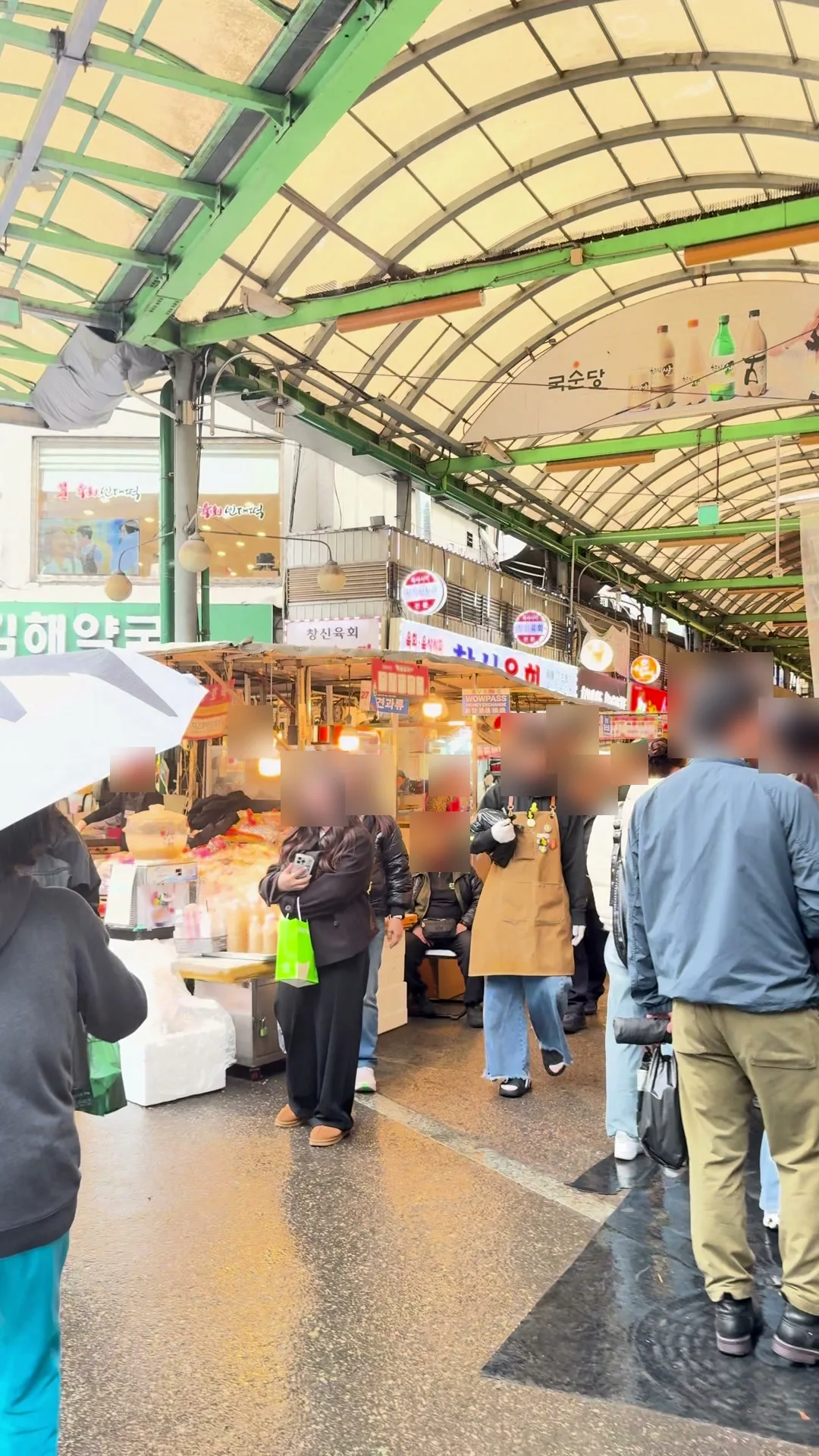
Gwangjang Market (광장시장) opened in 1905, and Korean tourism sources call it the country's first permanent market. The address is 88 Changgyeonggung-ro, Jongno-gu. Its famous food alley forms a cross where the East Gate, North Gate 2 and South Gate 1 meet, according to VisitKorea.
It works as two markets under one roof. The general market, about 200 restaurants and shops for clothing, bedding and crafts, centers on a three-story building from 1956 and runs toward the West Gate. The Gwangjang Traditional Market, about 250 mostly street stalls, runs from the food alley to the East Gate. Each side has its own merchants' association, Yonhap reported in November 2025.
That split matters. Most overcharging stories in Korean news involve the street stalls, and the general shops have complained that they lose customers over it.
Upstairs, Seoul City describes more than 100 meters of fabric wholesalers plus tailor-made hanbok shops. Official listings also show a vintage clothing arcade on the second floor; more on its status below.
I came in through the covered east entrance. The first signs I saw were for Changsin Yukhoe (창신육회), a beef tartare place, and a small "WOWPASS Money Exchange" board. Rain didn't thin the crowd at all. The central alley was packed with foreign visitors, some still pulling suitcases.
Gwangjang Market hours by section
| Section | Hours | Closed |
|---|---|---|
| Food alley | 09:00 to 23:00 | Open all year |
| General shops (fabric, hanbok, bedding) | 09:00 to 18:00 | Sundays |
| Vintage arcade (2F) | 10:00 to 19:00 | Sundays (open on public holidays) |
These are the official hours on VisitSeoul (page updated October 7, 2026, and unchanged when I checked on November 15) and VisitKorea, and they match the market's own notice. Each stall keeps its own hours, and many pack up well before 23:00. One Korean review lists Soonhee-ne Bindaetteok at 10:00 to 21:00.
Sunday is the catch. Only the food alley opens.
I couldn't find an official answer on whether stalls open on the Seollal and Chuseok holidays, so check locally if your trip lands on one.
How do you get to Gwangjang Market?
The closest stop is Jongno 5-ga Station on Line 1. VisitSeoul puts Exit 8 just 62 meters away. The market's own directions also give Euljiro 4-ga Station (Lines 2 and 5), Exit 4, about 100 meters away. From that side you cross the Cheonggyecheon Stream and come in from the south.
Buses stop at "Jongno 5-ga, Gwangjang Market" (종로5가.광장시장). In my video I started at an entrance of the Jongno Underground Shopping Center, walked along the Jong-ro sidewalk past the Gwangjang Market bus stop, and reached the arched market sign and the covered east entrance about 30 seconds after the stop. The video doesn't show a subway exit number, so aim for Exit 8.
Coming from Dongdaemun? Walk west along Jong-ro. A third-party listing built on tourism-board data puts it at about 11 minutes from Dongdaemun Station Exit 9; I haven't timed it for this guide. If you're pairing the two, my Dongdaemun Market guide covers the day and night hours over there.
Gwangjang Market prices: what to eat in 2026

VisitSeoul names the market's best-known foods as bindaetteok and assorted jeon (pan-fried savories), gimbap, sundae with pork head meat, yukhoe and donggeurangttaeng (small meat patties). Here's what they cost on menus and in Korean reviews from May to October 2026:
| Dish | Typical 2026 price | Based on |
|---|---|---|
| Bindaetteok, 1 piece | ₩5,000 to ₩6,000 | Menus, reviews (May to Oct) |
| Mayak gimbap, 1 serving | ₩3,000 to ₩5,000 | Menus, reviews (Jun to Oct) |
| Yukhoe, 1 plate | ₩20,000 to ₩23,000 | Menus, reviews (Sep to Oct) |
| Yukhoe bibimbap | ₩10,000 to ₩15,000 | Menus, reviews (May to Sep) |
| Kalguksu | About ₩6,000 to ₩7,000 | Reviews (Aug to Sep) |
| Tteokbokki, 1 serving | ₩4,000 to ₩5,000 | Review, news (Nov 2025, Sep 2026) |
| Sundae | ₩5,000 to ₩10,000 | My photo (Nov), news (Nov 2025) |
| Mixed jeon plate | About ₩15,000 | News, review (Oct) |
| Makgeolli, 1 bottle | ₩4,000 to ₩6,000 | Stall menu |
Prices vary by stall, and so do portions. Use the table to spot a number that looks way off, then go by the board in front of you. Several 2026 English guides still quote yukhoe at ₩8,000 to ₩15,000 or bindaetteok at ₩3,000 to ₩4,000, well below what current menus show.

Bindaetteok is the one to watch being made. In the central alley I filmed cooks frying mung bean batter on wide griddles under the Bakga-ne (박가네) and Hwanghaedo Wonjo Bindaetteok (황해도 원조빈대떡) signs, with finished pancakes stacked on the counters. Many of the vendors wore red aprons.

Mayak gimbap are small rolls served with a mustard dipping sauce. "Mayak" means "drug," a nickname for how hard they are to stop eating, and VisitSeoul calls Monyeo Gimbap (모녀김밥) the original. Yukhoe is raw beef, usually topped with a raw egg yolk, so skip it if you're pregnant or have a weak immune system.
For noodles, Gohyang Kalguksu, Cho Yonsoon's stall, appeared in Netflix's "Street Food: Asia" in 2019.
I filmed several posted prices on my visit. One snack stall had an English photo menu with sundae at ₩5,000 and a spicy pork stir-fry at ₩10,000.

The overcharging controversy: what happened and what changed
| When | What happened |
|---|---|
| Nov 2023 | A YouTuber's ₩15,000 mixed jeon plate looked skimpy and the vendor pushed for more orders. The merchants' association suspended the stall for 10 days. |
| Dec 2023 | Seoul, Jongno-gu and the merchants announce weight labels on menus, food models, mystery shoppers and more training. |
| 2024 | Jongno-gu runs 241 mystery-shopper checks, adds QR menus in 20 languages at 88 stalls and brings a card payment service to 77 stalls. |
| Nov 2025 | A viral video shows a vendor asking ₩10,000 for an ₩8,000 sundae after adding meat the YouTuber says he never asked for. The stall is suspended for 10 days. |
| Dec 2025 | The SMEs ministry, Seoul, Jongno-gu and both merchants' associations agree on clear price display, transparent payment and multilingual signs. |
| Apr 2026 | A stall charges ₩2,000 for bottled water and gets a 3-day suspension from the association. |
| May to Jun 2026 | Seoul and Jongno-gu send in Korean and foreign mystery shoppers. A stall real-name system with penalty points starts in June. |
| Aug 2026 | Reporters posing as foreigners are charged ₩1,500 for water listed at ₩1,000. No stall had received penalty points yet. |
| Sep 2026 | A national rule suspends registered restaurants for 5 days on a first offense of not posting prices or charging above them. |
| Sep to Oct 2026 | Jongno-gu takes three administrative actions each month, mostly over hygiene. |
Put that together and the picture is mixed. The weight labels announced in 2023 never really arrived: Seoul Economic Daily reported in April 2026 that the plan stalled over merchant pushback and a weak legal basis. So don't expect grams on the menu.
The September rule is real and strict, and it applies to registered restaurants. Maeil Shinmun reported in October 2026 that unregistered street stalls fall outside it, because there's no business license to suspend. The stalls answer to Jongno-gu's real-name system instead, under which more than 120 penalty points in a year or a fourth violation can cost a vendor the street permit.
Enforcement got going late. In August, three months into the point system, no stall had been penalized. By November 4, Seoul Economic Daily was reporting six administrative actions across September and October.
If you're overcharged, point at the board and say the posted price. If that fails, call the 1330 Korea Travel Hotline (+82-2-1330, English available) or Seoul's 120 line. A Korean consumer guide from October 2026 suggests photographing the board before you order, which makes any complaint easier.
How ordering, seating and paying work
Street stalls sit in the middle of the aisle. You take a spot on the bench at the counter, order from the board, and pay when you leave, a Korean reviewer explained in September 2026. Restaurants line the walls and have more seats; Bakga-ne, for one, fills a three-story building.
The alleys are narrow, and queues blend into the foot traffic. A Seoul City writer advised checking where a line really ends before joining it. Solo eaters are common, and one bindaetteok goes further than you'd think, so groups usually share.
In 2024 Jongno-gu added multilingual QR menus at 88 stalls. I didn't check whether they're still on the counters.
Payment is where the official line and reality split. VisitKorea's listing says "Cards: Accepted," which describes the market as a whole. At the stalls, the record is shakier. In September 2024 the merchants said most stalls had card readers, while a YTN check that month found 3 of 5 shops refusing cards. In November 2024 Jongno-gu said the stalls' shared terminals worked with Korean cards only. And in February 2025 Seoul City's own English site said many vendors still refuse cards.
Sit-down restaurants look like a better bet for cards: a September 2026 Korean review shows a card payment at a bindaetteok restaurant there. I didn't film a card sign at any stall, so I can't tell you whether your foreign card will work at a given counter.
Bring cash in ₩1,000, ₩5,000 and ₩10,000 notes. I saw that WOWPASS money exchange sign near the east entrance but didn't go in. If you're unsure how WOWPASS handles cash exchange and payment, my WOWPASS vs NAMANE comparison walks through it.
Is Gwangjang Market a tourist trap?

My honest answer: it's a tourist market now, with a few bad actors, and most visitors pay roughly the prices above.
The case for "trap" is real. The incidents keep coming, one stall kept two menu boards with different water prices, and enforcement only picked up this fall. On a busy Saturday it's crowded and hurried.
The case against is real too. Most complaints involve a handful of street stalls, and the general shops and restaurants sit under different rules. Bindaetteok at ₩5,000 to ₩6,000 is still an inexpensive snack in central Seoul. And visitors keep voting with their wallets: Seoul City data released on November 3, 2026, showed foreign card spending at Gwangjang Market up 113.4% from January to September compared with a year earlier.
What I filmed fits the "tourist market" label. Near the central alley there's a ZZANG GAMES claw machine shop, an HBAF almond store and a cosmetics pop-up, and many stalls sell imported snacks such as Haribo and Kopiko.
So go for the bindaetteok, the noise and the griddles. Eat where the board is printed and clear, and you're unlikely to have a problem.
Where is it quieter?
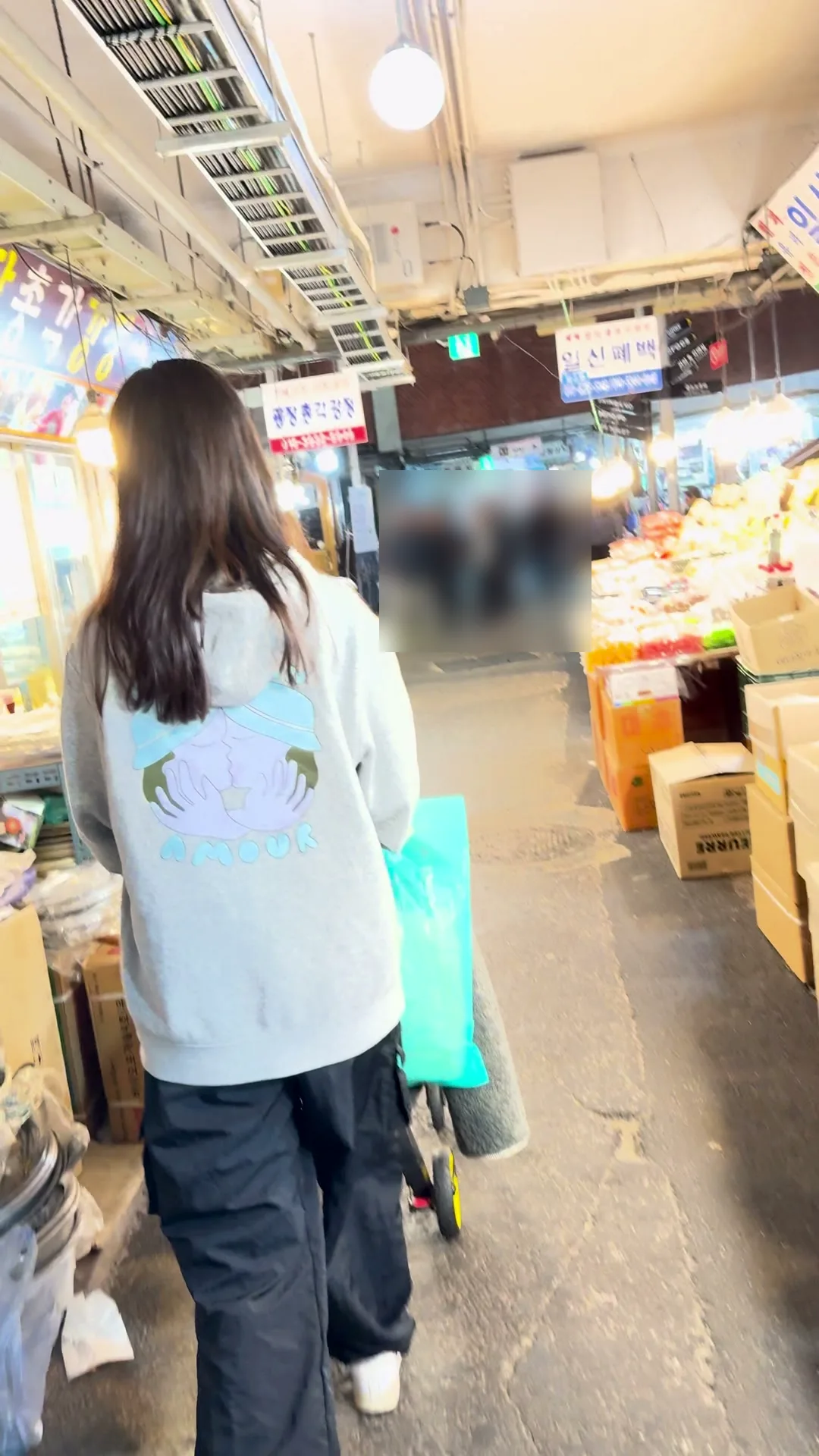
Step one aisle back. On my rainy Saturday the central food alley was jammed, while a back aisle lined with boxes of dried goods had room to walk.
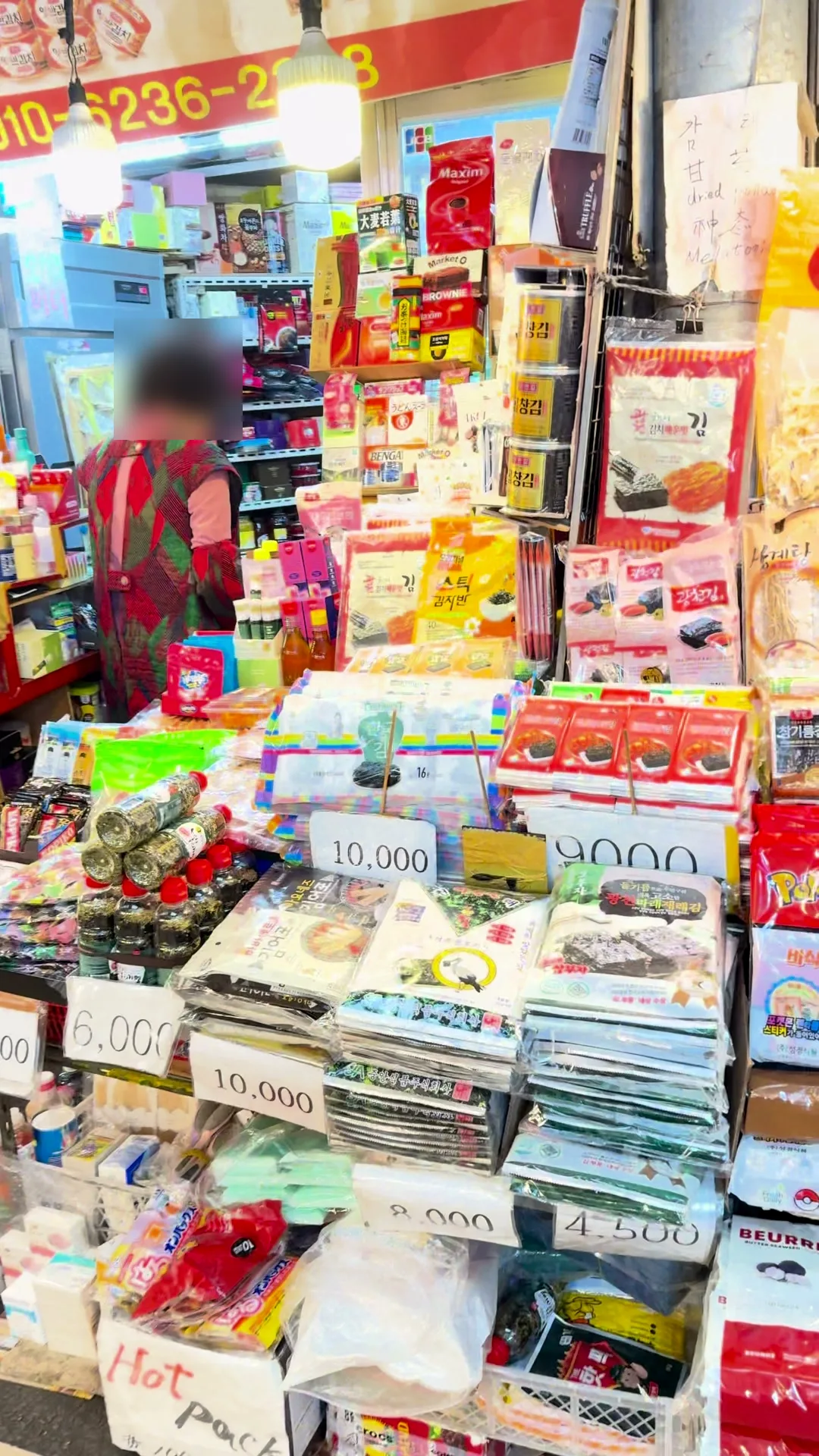
Dried seaweed (gim) makes an easy souvenir. One seaweed stall I passed had printed price cards on its packs, ₩4,500 to ₩10,000.
For timing, Korean and English guides agree on a rule of thumb (no official figure): weekday mornings and early afternoons are calmer, and evenings, weekends and holidays are busiest. Need a restroom? Korea Tourism Organization's accessibility site lists an accessible restroom at the rest area by South Gate 1.
Beyond food: fabric, hanbok, vintage and new shops
The upper floors are where the older market lives on: fabric by the meter, hanbok tailors, bedding. If fabric is your main goal, the Dongdaemun fabric market is bigger.
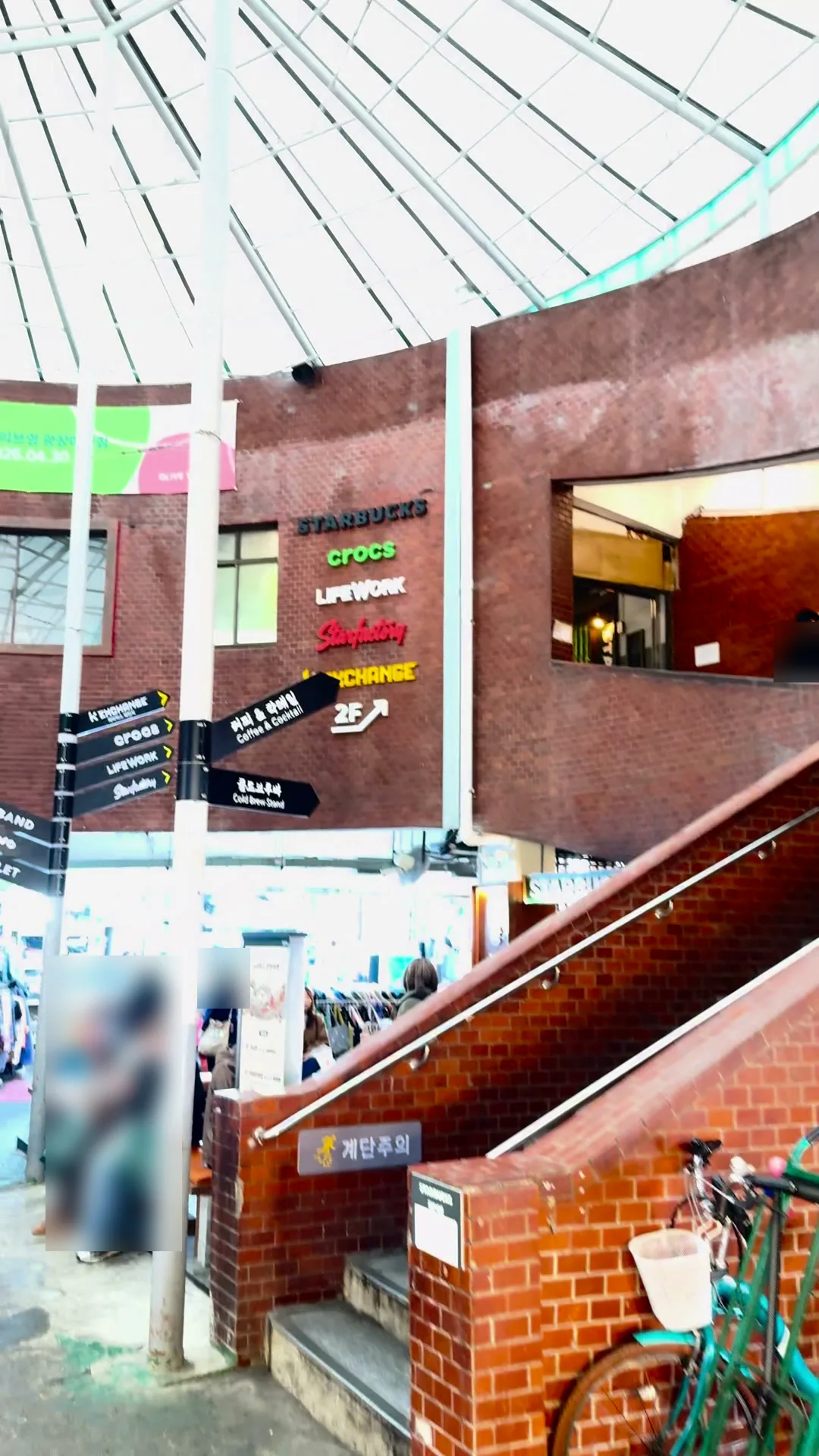
Newer anchors have moved in. Starbucks Gwangjang Market opened on May 29, 2025, with about 250 seats over two floors and a rooftop, ZDNet reported. I saw it up the stairs in a brick building, with a pillar sign pointing the way and a board listing Crocs, Lifework and an exchange on 2F. Olive Young opened a store on the second floor of the silk and fabric section on April 30, 2026, according to the company.
How to find Starbucks inside the market
Starbucks isn't on the central food alley, so look up instead of searching the street. Hanging signs with the green Starbucks logo and an arrow point the way, alongside signs for Olive Young and Gwangjang Fashion.

On my visit, following those signs took me out of the crowd, along a quieter back aisle stacked with boxes of dried goods, to a brick building with a staircase up to the second floor. That's the Starbucks building in the next photo. The signs are easier to follow than any written directions, since the market has several entrances.
The vintage arcade is the open question. It's officially 10:00 to 19:00, Monday to Saturday. A Korean outlet reported in March 2026 that it had shrunk from about 150 shops to about 30. I didn't go up on this visit, so I can't confirm what's open; treat older guides that describe a busy vintage floor with caution.
Food tour or DIY?
Do it yourself first. Pick a stall with a printed board, point, sit, and pay when you're done. That's all the system there is.
A tour makes sense if you want someone to explain each dish, or you'd rather not handle ordering and paying in a crowd. Klook's "Gwangjang Market Half-Day Street Food Experience with Souvenir" is a two-hour English-language group tour with tastings, a stamp challenge and a souvenir. As of November 1 the listing said it isn't suitable for vegetarians. I haven't checked the current price, so look at it on the page.
What's near Gwangjang Market?
South Gate 1 opens onto the Cheonggyecheon Stream at Majeongyo Bridge, so a walk along the water is right there. Jongmyo Shrine is about 10 minutes away on foot, roughly 500 meters.
Seoul City's Dongdaemun heritage walk starts here: the food alley, then Cheonggyecheon, Heunginjimun Gate, the Hanyangdoseong Museum and Dongdaemun Design Plaza. It ends in the district where I work.
FAQ
Is Gwangjang Market open on Sunday?
The food alley is, 09:00 to 23:00. The fabric, hanbok and vintage shops close on Sundays.
How much does food cost at Gwangjang Market in 2026?
Typical fall 2026 prices: bindaetteok ₩5,000 to ₩6,000, mayak gimbap ₩3,000 to ₩5,000, yukhoe ₩20,000 to ₩23,000. Prices vary by stall, so check the posted board.
Do Gwangjang Market stalls take credit cards?
Some do. Many still prefer cash or bank transfer, and in late 2024 the stalls' shared terminals were reported to take Korean cards only. Bring small bills.
Is Gwangjang Market a tourist trap?
It's touristy, and a few stalls have overcharged. Eat where prices are posted, confirm the total, and you'll usually pay what the board says.
Which subway exit is closest?
Jongno 5-ga Station (Line 1), Exit 8, about 62 meters away.
Is the vintage market still open?
Officially yes, 10:00 to 19:00, Monday to Saturday. A March 2026 report said only about 30 shops remain. I haven't checked it in person.
Quick checklist
- Cash in ₩1,000, ₩5,000 and ₩10,000 notes
- Food alley 09:00 to 23:00 daily; shops closed Sundays
- Jongno 5-ga Exit 8 or Euljiro 4-ga Exit 4
- Read the posted board before you sit
- A photo of the board, just in case
- Confirm the total before you pay
- Say no to dishes you didn't order
- 1330 Korea Travel Hotline saved in your phone
Related guides
- Dongdaemun Market 2026: Day vs Night Hours and How to Shop
- Dongdaemun Fabric Market 2026: Floors, Hours and How to Buy
- Korean Clothing Sizes Explained (2026): 44/55/66, 95/100/105 and Shoe Sizes
Sources
- VisitSeoul: Gwangjang Market (Korean, updated October 7, 2026, checked November 15, 2026)
- VisitKorea: Gwangjang Market (English, checked November 15, 2026)
- Gwangjang Market official site: opening hours (Korean)
- Gwangjang Market official site: directions (Korean)
- VisitKorea: Gwangjang Market (Korean)
- Access VisitKorea: Gwangjang Market accessibility (Korean, updated August 14, 2025)
- Seoul Metropolitan Government: Gwangjang Market (English, January 23, 2020)
- Seoul Metropolitan Government: Generation Z Falls in Love with Gwangjang Market (English, February 17, 2025)
- Seoul City Mediahub: Dongdaemun history and culture walk (Korean, June 11, 2021)
- Seoul City Mediahub: weight labels and anti-overcharging measures (Korean, December 4, 2023)
- Seoul City Mediahub: Gwangjang Market food alley (Korean, February 24, 2025)
- Korea.kr policy briefing: Gwangjang Market trust recovery meeting (Korean, December 5, 2025)
- Ministry of Food and Drug Safety: stricter penalties for not posting prices (Korean press release, September 1, 2026)
- CJ Olive Young: Gwangjang Market store opening (Korean, April 30, 2026)
- Netflix: Street Food: Asia
- Segye Ilbo: stall suspended for 10 days over ₩15,000 jeon plate (Korean, November 24, 2023)
- Munhwa Ilbo: Gwangjang Market stalls now take cards (Korean, September 13, 2024)
- Seoul Economic Daily: card terminals refused at stalls (Korean, September 30, 2024)
- Energy Economy: terminals take Korean cards only (Korean, November 3, 2024)
- Munhwa Ilbo: Jongno-gu stall real-name system (Korean, November 6, 2025)
- Yonhap: two merchants' associations in dispute (Korean, November 23, 2025)
- Seoul Economic Daily: ₩2,000 water and stalled weight labels (Korean, April 21, 2026)
- Yonhap: mystery shoppers and real-name system from June (Korean, May 20, 2026)
- Maeil Business: double menu boards and reused side dishes (Korean, August 31, 2026)
- Hankyung: first offense means suspension (Korean, September 2, 2026)
- Maeil Shinmun: street stalls fall outside the new rule (Korean, October 5, 2026)
- Maeil Shinmun: photograph the menu board before ordering (Korean, October 5, 2026)
- Hankyoreh: foreign card spending at Gwangjang Market up 113.4% (Korean, November 3, 2026)
- Seoul Economic Daily: foreign spending at Gwangjang Market doubles, six actions in September and October (English, November 4, 2026)
- ZDNet Korea: Starbucks Gwangjang Market opens (Korean, May 29, 2025)
- Le Desk: the second-floor vintage arcade empties out (Korean, March 10, 2026)
- Food & Wine: Street Food chefs, including Cho Yonsoon (April 30, 2019)
- Third-party: Polle, Wonjo Soonhee-ne Bindaetteok menu (Korean)
- Third-party: Polle, Tongkeun Nuine menu (Korean)
- Third-party: Naver blog review with card payment (Korean, September 2026)
- Third-party: Siksin, Gwangjang Market bindaetteok (Korean, May 7, 2026)
- Third-party: Tripsoda, Gwangjang Market food guide (Korean, June 23, 2026)
- Third-party: Seoul Now, Gwangjang Market food guide (October 2, 2026)
- Third-party: yum82, Gwangjang Market food guide (October 8, 2026)
- Third-party: Korea with Binibi, where to eat at Gwangjang Market (September 2026)
- Third-party: firstkfood, Gwangjang Market food guide (August 25, 2026)
- Third-party: After40, Bakga-ne review and how stalls work (Korean, September 7, 2026)
- Third-party: tripinfo, walking times from nearby stations (Korean)

